Posted by the_influ3nce on August 16, 2026, 11:12 pm
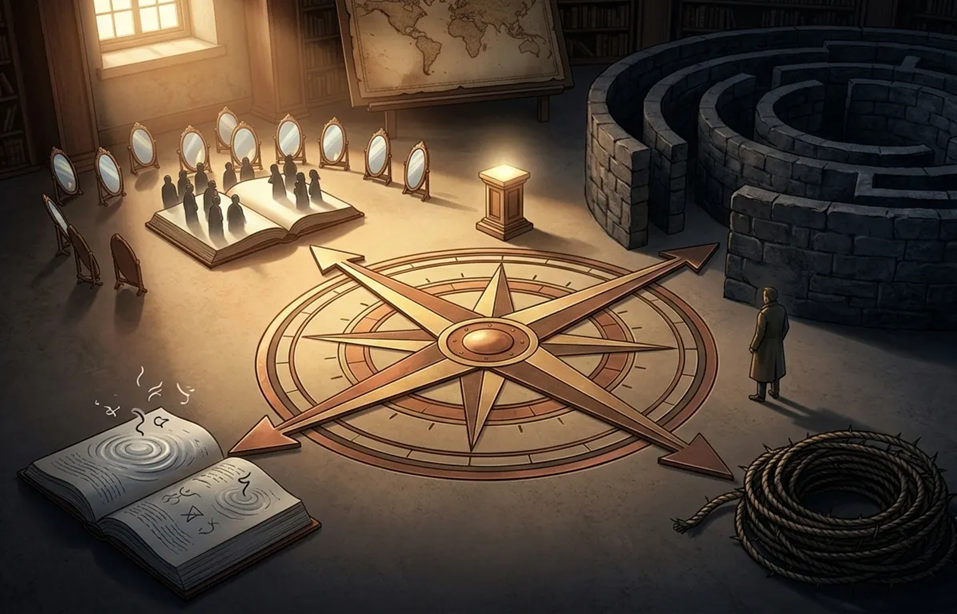
The Witness - THE MAP
From The Witness
Read this first if you read nothing else.
This is not a book about villains. It is a book about a structure, and about what the structure does to everyone inside it, including the people running it. If you are looking for monsters, you will not find them here, and the looking will cost you, because the search for monsters is one of the structure’s oldest tools for making sure the structure itself stays out of view.
What you will find is a mechanism. It is old. It is not complicated.
And once you see it you will not be able to stop seeing it, which is both the point and the price of the book.
THE INVENTORY
Before anything else, before the first wall and the first story and the first king, there was an inventory. Not a written one. Not a conscious one.
But every human group that ever stayed in one place long enough to be worth exploiting was running one, and so was every opportunist shrewd enough to read it.
The inventory asks one question. What does everyone here need that they cannot make or find for themselves. Not what they want.
What they cannot refuse.
The distance between want and cannot refuse is the entire margin.
The margin is what the book is about.
The hard inventory is the body.
Ground to stand on, because a person with nowhere to stand will accept almost any terms to get some.
Water, because three days without it and the negotiation is over.
Food. Warmth. Shelter. Salt, because the body is a machine that requires it and produces none.
The power to move things, muscle first, then wind and water and fire.
Then the stored ancient fire of coal and oil.
The seed, because whoever owns next year’s seed owns next year’s harvest and everyone who needs to eat from it.
The knowledge of how to do the things that keep everyone alive.
Minding that knowledge concentrated in one set of hands is a wall that reproduces itself without mortar.
The soft inventory is the identity.
The need to belong, because for almost the entire span of human existence, exile from the group was a slower word for death.
The need for meaning, because a person without a story that makes their suffering make sense is in a particular kind of agony, and agony creates a buyer.
The need to be seen as above someone, anyone, on the ladder, because the person who has nothing else will defend that.
This also creates a need for someone to believe the arrangement is fair, because a person who believes the arrangement is fair does not organize against it. And a person who organizes costs money to suppress, whereas a person who believes in the arrangement costs nothing.
Every item on the soft inventory runs on a single fuel:
attention.
You cannot feel belonging without attending to other people and knowing they are attending to you.
You cannot feel meaning without directing attention toward the thing that carries it and having someone register that you are there.
You cannot feel seen as above someone without that someone’s attention landing on you and registering the comparison.
You cannot maintain the belief that the arrangement is fair without sustained attention to the story and the withdrawal of attention from the gap.
Attention is to the soft inventory what salt is to the hard inventory:
the underlying necessity without which none of the other items can function.
The machine figured this out before anyone named it, and the last item in the inventory’s progression is the evidence:
salt becomes oil becomes credit becomes attention.
Not because attention is simply the newest thing on the list.
Because it is the fuel the entire soft inventory runs on.
The deepest necessity, gated by the same logic as every wall that came before it.
The inventory has not changed in ten thousand years. The mechanisms for gating it have become more sophisticated.
The gate moves.
The need does not.
THE FIRST MOVE
The first move is always the same, and it was being made before anyone had a word for it.
Claim the thing before anyone else has thought to claim it.
The ground itself, first, because everything else sits on the ground. Then the water on it and under it.
Then the power sources that move through it.
Then the seed that grows from it.
Then the knowledge of how to work it.
Then the meaning that makes the working bearable.
Early arrival is most of the work.
The claim that is old enough looks like nature.
The person born inside an arrangement that was already old when their grandparents arrived does not experience it as a claim.
They experience it as the shape of the world.
That conversion, from claim to nature, from feeling it like a decision to feeling it like the weather, is the single most valuable thing the opportunist ever produces.
And it costs almost nothing once enough time has passed.
Time is the cheapest legitimacy there is.
But time alone is not enough, because time can be waited out and claims can be challenged.
So the first move has a second part.
Get the claim written down, in law, in custom, in story, so that challenging it requires challenging the entire system.
The system of writing and law and story rather than just the original act of taking.
At that point the person who questions the arrangement is no longer asking a practical question about who got there first.
They are attacking the foundations of everything.
That feeling, the vertigo of seeming to attack everything by questioning one thing.
That feeling is manufactured.
It is the claim’s best defense, and it was being manufactured long before anyone understood they were manufacturing it.
THE TWO TOOLS
Once the inventory is read and the first claim is made, only two tools do the remaining work.
They are not inventions.
They are discoveries, made independently by every successful opportunist in every era on every continent, because they are the only two tools the situation offers.
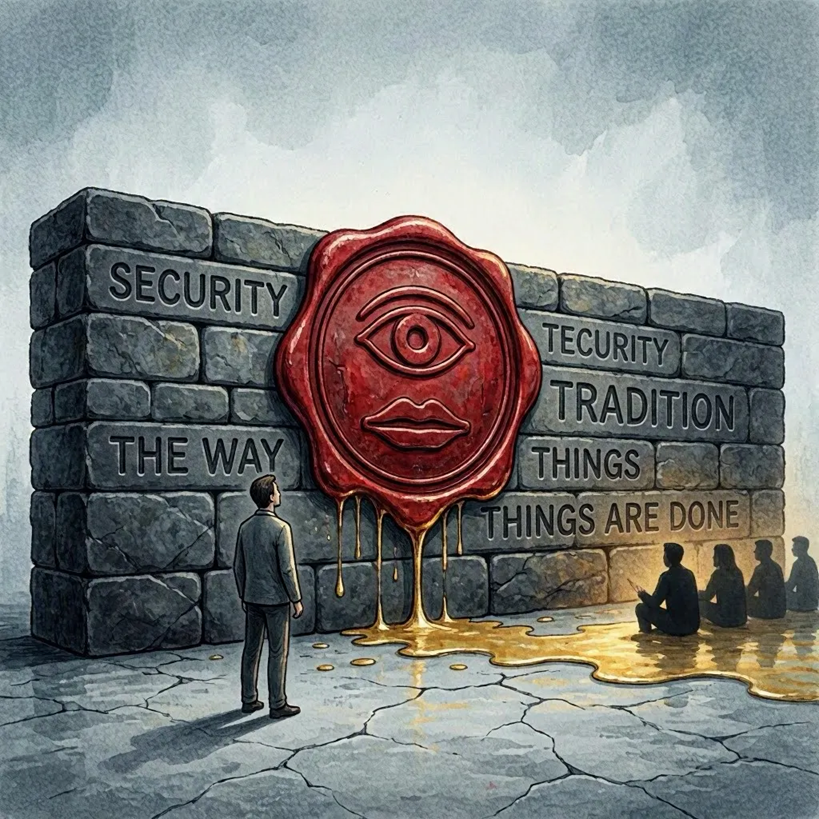
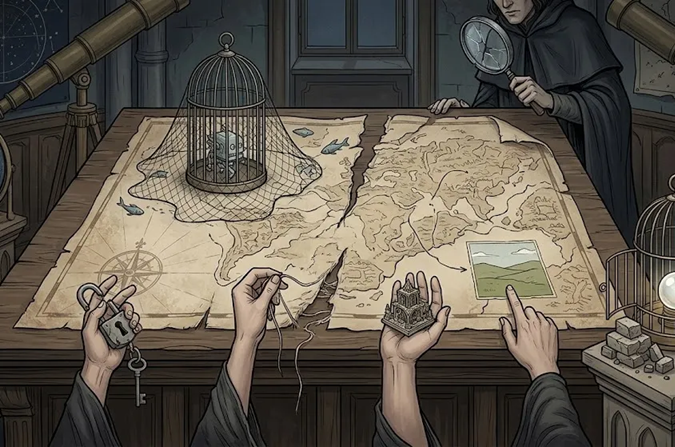
The first tool is the wall.
Get between the body and the thing it cannot refuse and name your price.
The price is whatever the alternative costs, and the alternative is always worse. Because It has been arranged for it to be.
The wall does not need to be visible.
The best walls are the ones the person behind them helps to maintain. They have been persuaded that the wall is the thing keeping something worse out rather than keeping them in.
Two things about the wall that most books on this subject get wrong.
First, there are two opposite versions of it and confusing them is fatal.
The first version blocks a necessity and charges for it.
The cure is to tear it down and get the thing to the body that needs it.
The second version removes the body’s natural stopping point and floods it with more than it can process: engineered food that defeats satiety, a feed that never ends, an alarm that never lets you rest.
The flood does not feel like a wall. It feels like abundance.
The cure is the exact opposite of the cure for the first version: not more but less, an off-switch, a reason to stop.
Hand a drowning person more water and you will call it mercy.
Ration a starving person further and you will call it discipline.
Getting the two confused is not abnormal.
Keeping them confused is part of the design.
Second, every wall in this book was built on top of the first wall.
Which is the land itself.
The salt is in the ground.
The water is in the ground.
The seed grows from the ground.
The mine is under the ground.
The factory stands on the ground.
The person with no ground has nowhere to stand and must require permission from someone who has some.
Which means every other negotiation the person with no ground ever enters will happen inside someone else’s enclosure before it begins.
The land claim is not one wall among many.
It is the wall the other walls are built on.
The second tool is the story.
The story does what the wall cannot do alone: it makes the wall feel like the horizon.
The wall stops you. The horizon is just where the world ends.
You do not organize against a horizon.
The particular kind of story that converts a wall into a horizon takes something genuinely true.
Something like a real service, a real protection, a real love, and uses its truth as the carrier for an untestable claim about why the arrangement is just.
The genuine part makes the whole thing credible.
The untestable claim is what makes the arrangement permanent, because a claim that cannot be tested cannot be defeated by evidence.
a claim that cannot be tested is dangerous.
The tell for this kind of story is precise and reliable.
Genuine care does not need the untestable claim.
The person who actually serves you does not need you to stop asking questions about them or their service.
When the caring arrives bundled with a demand that you stop asking, the bundle is the tell. The care can be real.
The demand is the road the arrangement is traveling down.
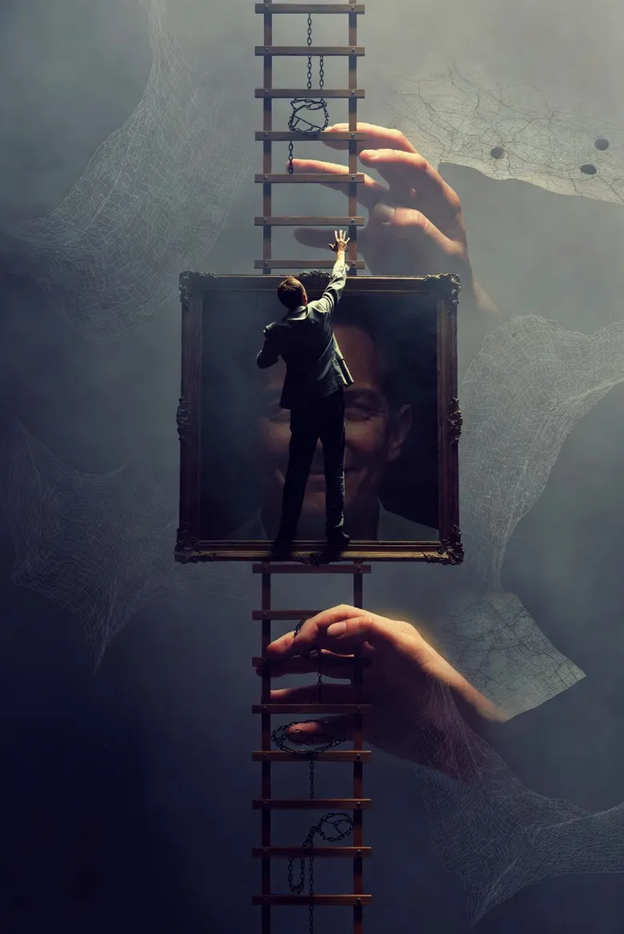
THE LADDER
There are not two kinds of people.
The ones who build the walls and the ones who live behind them.
There is one kind.
You are standing on a ladder, and you do to the rung below you roughly what is done to you from the rung above.
The hand that seals the room is, far more often than you will want it to be, your own, reaching down even as another hand reaches down at you.
This is not a book for people who are already clean.
There are no such people, and a book written for them would be a book written for no one.
This is a book for people who are still inside the thing it describes, which is everyone, including the person who wrote it.
THE SIGNALS
Here is the part of the map that took the longest to find, because it runs in two directions at once and most accounts of power only follow it in one.
Shame, fear, and the recognition of hypocrisy are signals.
They are the body and the identity doing exactly what they are supposed to do. Shame arrives when you have violated your own values.
It is supposed to be felt, prompt a correction, and release.
Fear arrives when something threatens you or someone you are responsible for. It is supposed to be felt, inform a decision, and release. Hypocrisy arrives as the discomfort of noticing that your conduct has drifted from your stated values. It is supposed to be felt, prompt realignment, and release.
None of these signals are problems. All of them become problems when the release is blocked.
The opportunist’s deepest tool is not the wall and not the story.
It is the conversion of these signals from temporary messengers into permanent cages.
Manufactured shame that never releases becomes self-erasure.
Fear that never releases becomes chronic alarm that destroys the brake permanently. The brake being the part of the mind that can weigh and decide and push back.
Hypocrisy that is never resolved but only defended becomes the entire identity. Now they are the person who must spend all their energy maintaining the gap rather than closing it.
A person living permanently inside any of these three is a person whose brake is disabled and who will accept almost any arrangement that promises relief.
Even the one that manufactured the feeling in the first place.
But the signals run in the other direction too, and this is what the opportunist most fears.
Genuine shame, pointed outward at real harm rather than inward at the doubter. That outward shame towrds real harm has stopped more arrangements than any army.
Genuine fear of consequence, felt by the people running the machine rather than by the people inside it.
It is what has ended more abuses than any argument.
And hypocrisy, named precisely in public, in front of the audience that believed the story, is the single most destabilizing force in this entire book.
It uses the arrangement’s own words as the weapon, and the audience that accepted those words cannot dismiss the contradiction without admitting they were deceived. And people will move very far and fast to avoid that admission, including turning on the deceiver.
The opportunist’s defense against the hypocrisy move is not to close the gap between conduct and claim.
It is to destroy the credibility of the person holding the mirror.
They hope before the audience has time to look into it.
Watch for that move. It appears in this book more than any other.
THE MACHINE AND ITS OPERATORS
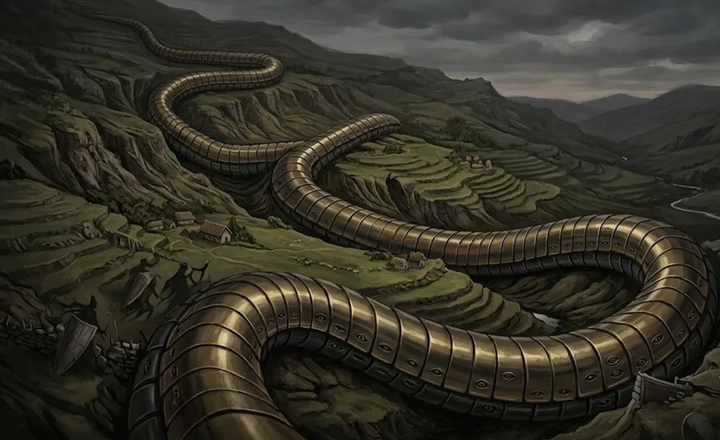
The machine is not a conspiracy. No single hand directs it.
It runs because at every junction, in every century, the path of least resistance ran in the same direction:
toward extraction,
toward consolidation,
toward the quiet removal of friction.
It moves the way water moves down a hillside, not because the water has a plan, but because that is where the ground slopes.
Picture the most ruthless person you have ever heard of.
Now strip away the things that limit them.
Take away the aging body,
the fear of death,
the bad conscience that wakes them at three in the morning,
the shame that makes them flinch when someone sees what they did.
Take away the death itself.
What is left is not a person. It is the machine.
The machine is what ruthless opportunism looks like when it is freed from every brake that holds an ordinary human in check.
What is left is the worst opportunist that never dies, never forgets, never feels watched, and meets no resistance.
Opportunism does not take what it wants.
It takes what it can.
Those are different things and the difference is the entire story.
The machine takes exactly as much as the absence of resistance allows, and not one inch less.
There is no hand on the wheel.
There is only an opportunity that was once never refused.
Repeated for ten thousand years, in every place where nothing and no one who pushed back could stop it.
Now the part that is hardest to say and most necessary.
The people at the top of the machine are not free. They are trapped.
They are the most thoroughly trapped people in the structure, and the trap is the one described in the inventory. The soft inventory, the one that runs on wanting.
The neuroscience is in this book, in the post about the loop: the wanting circuit and the liking circuit are separate, and the wanting can be cranked far higher than the liking will ever reach.
You can crave something far more intensely than you will ever enjoy getting it.
The unpredictable reward, the next deal, the next acquisition, the next rung. These all produce the most compulsive seeking of all.
There is no “enough”, and not because the person is uniquely evil, but because the mechanism that was supposed to produce “enough” has been overwhelmed.
The machine built to defeat other people’s off-switches has defeated the operator’s own long ago.
I want to hold this carefully, because this is one of the places in the book where the argument moves from documented territory into interpretation.
The neuroscience of wanting and liking is solid, decades of work by Kent Berridge and others. What I am doing with it is applying that framework to the behavior of people running large institutions, and that is an interpretive move, not a clinical finding.
I am not claiming executives have been diagnosed with anything.
I am pointing to a pattern of behavior:
the endless accumulation,
the inability to stop,
the filing away of everything else as a distraction.
It looks like a hunger that grows faster than the capacity to be full.
That frame is useful because it explains why the machine consistently overshoots rational self-interest.
It is an interpretive lens, not a proven neurological fact about specific people.
Hold it at that weight.
What the frame produces, held at that weight, is a description that matters because it changes what resistance looks like.
You cannot shame a person who cannot feel shame.
You cannot simply scare someone who has everything. If they live in a permanent state of alarm, any threat feels like the fear of losing everything.
The leverage is not personal. It is structural.
The machine stops when the friction becomes higher than the opportunity. Not when the operator becomes a better person.
Waiting for the latter is one of the seal’s most reliable ways of ensuring the former never arrives.
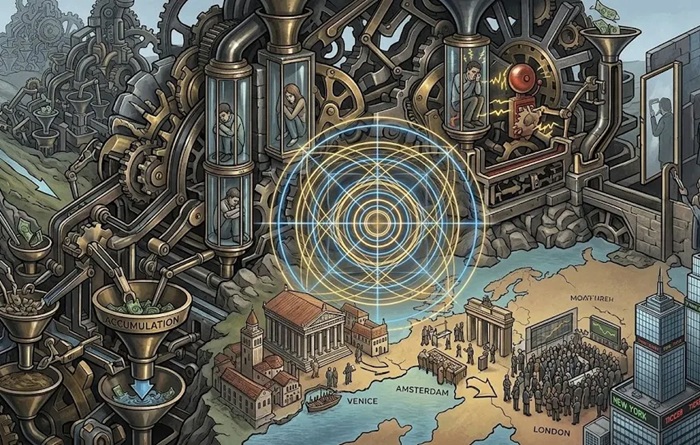
And it has a hub. Not a fixed place. A configuration.
The hub is wherever the most essential wants are most completely controlled.
Where the arrangement feels most like nature.
Where the money sits most comfortably.
Where the corrections are most loudly celebrated precisely because they threaten the structure least.
The hub moves.
From temple to trading floor, from Venice to Amsterdam to London to New York.
This book follows it from the first claim on the first piece of ground to the present hour.
THE HONEST WEAKNESSES OF THIS MAP
These patterns appear almost everywhere I look.
That is either a real discovery or a cheat, and I cannot fully rule out the cheat.
A pattern that explains everything explains nothing.
I cannot point to a single large modern society that ran for a century on neither pattern.
Which means I cannot prove I have found something real.
It may be a theory so broad that any data can be twisted to prove it right.
Watch for this the entire way through. I will watch for it too, out loud, where it happens.
Four ways to prove this map wrong.
Keep all four in your mind from here to the end.
One. These traps fall apart as fast as ordinary mistakes do when someone asks a hard question. They do not, but check me.
Two. Simply exposing the trap ends it. Leak the memo, print the truth, and the thing dies. It does not, and I will show you exactly why.
Three. You can find lasting, extractive power that runs on neither pattern. I have not found it. You might.
Four. A plain story, greed or accident or ordinary stupidity, explains a given case better than my patterns do. Sometimes it does.
I will mark those places myself.
One of them, late in the book, I lose outright and leave standing as a loss.
Everything after this is evidence, failure, and correction.