From The Witness
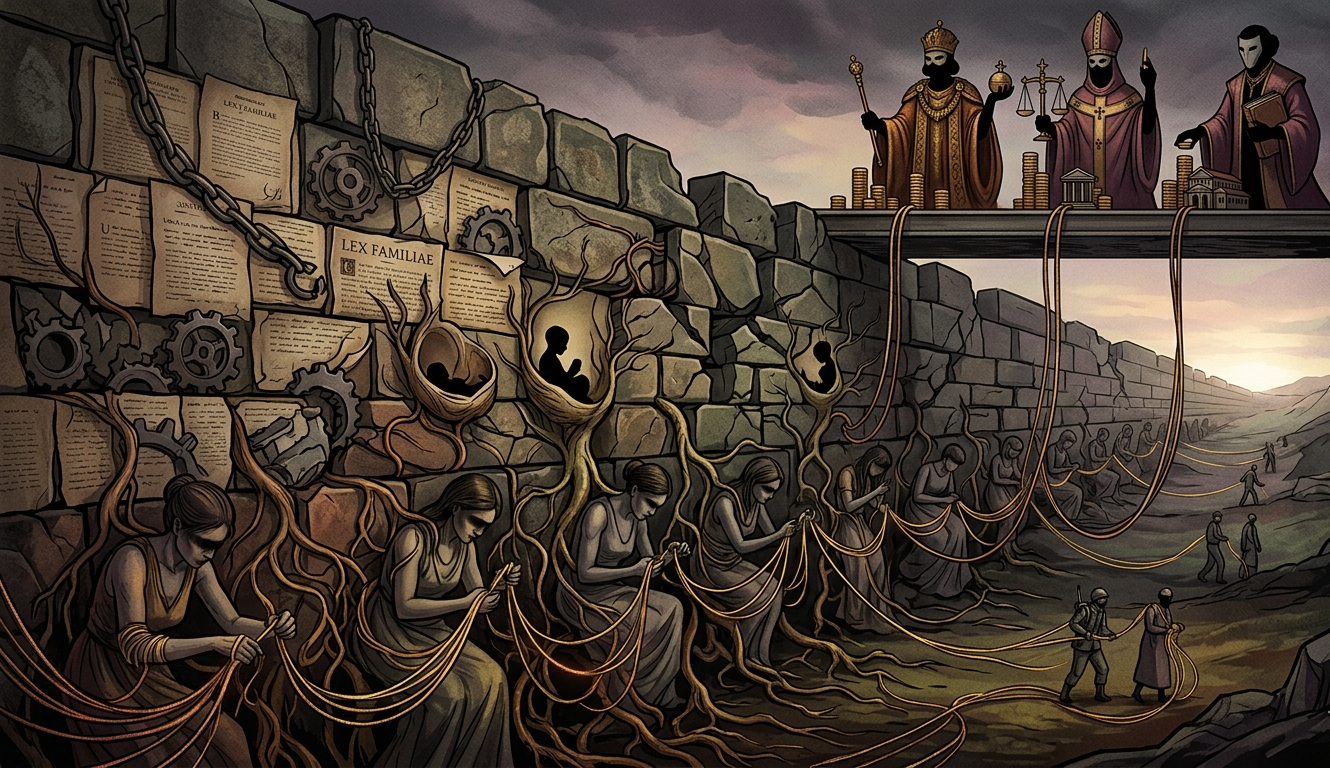
The inventory in the oldest want post names the body’s ancient hungers: salt, sugar, fat, belonging, fear.
There is one more item on the hard inventory that is older than any of these in its consequences and more fundamental in its political history, and it deserves its own post because it is the one the book most wants to handle carefully.
The body reproduces. Not every body, not every time, but the capacity to produce another body is distributed across roughly half the human population, and for the entire span of human history up to the very recent past it was not controllable by the person who possessed it.
That uncontrollability, combined with the absolute necessity of reproduction for the continuation of any group,
made the reproductive body the most fought-over piece of the inventory from the very beginning.
The ground can be owned. The salt can be monopolized. The surplus can be taxed. But nothing in the long history of extraction has been controlled as thoroughly, as intimately, or as violently as the body that makes the next generation.
The wall here is not metaphorical.
It is the most literal wall in this entire book, because it is built inside the body itself, or tried to be: the law that decides who may bear children and under what circumstances, the custom that transfers ownership of the reproductive body from father to husband at marriage, the religion that defines the body’s proper use and the punishment for deviating from it, the state that decides which pregnancies are permitted and which are criminalized and which are forced.
All of these are attempts to control the one resource that every group, every dynasty, every labor supply, every army requires, and that is produced by people who have their own interests in the matter.
The word family comes from the Latin familia, which did not mean what we mean by it now.
The familia was the household’s property, the slaves and the servants and the dependents, and in the original Roman law, the wife and children under the paterfamilias, the father of the family, who held legal power over them.
The family was a unit of ownership before it was a unit of love, and the love that grew inside it, the genuine and overwhelming love, is exactly the road through the caring: the realest thing there is, and the thing the arrangement of ownership traveled down.
This is not a post about whether family is good or love is real.
The love is real. The care is real.
The first room post later in this book is about the family as the place where the best human capacities are built. But the family as a legal structure, as a property arrangement, as the institution through which labor is reproduced at no cost to the people who consume the labor.
That is a different thing running alongside the love, and it has to be named in the inventory because it has been the primary mechanism by which the machine has reproduced itself, cheaply, generation by generation, inside the most intimate room of every human life. The next worker, the next soldier, the next consumer, the next person who will accept the arrangement because they were born inside it and it looks like the horizon. They will be produced in the family, mostly by women, mostly without wage, mostly without recognition that it is work at all, let alone the most essential work the whole structure depends on.
> To the top of the ladder: What is the literal price you would have to pay if the reproductive labor producing your next consumer suddenly demanded a wage?
>
> To everyone else: What portion of your own body’s capacity has been claimed by the state, the law, or the religion to reproduce the machine cheaply?