From The Witness
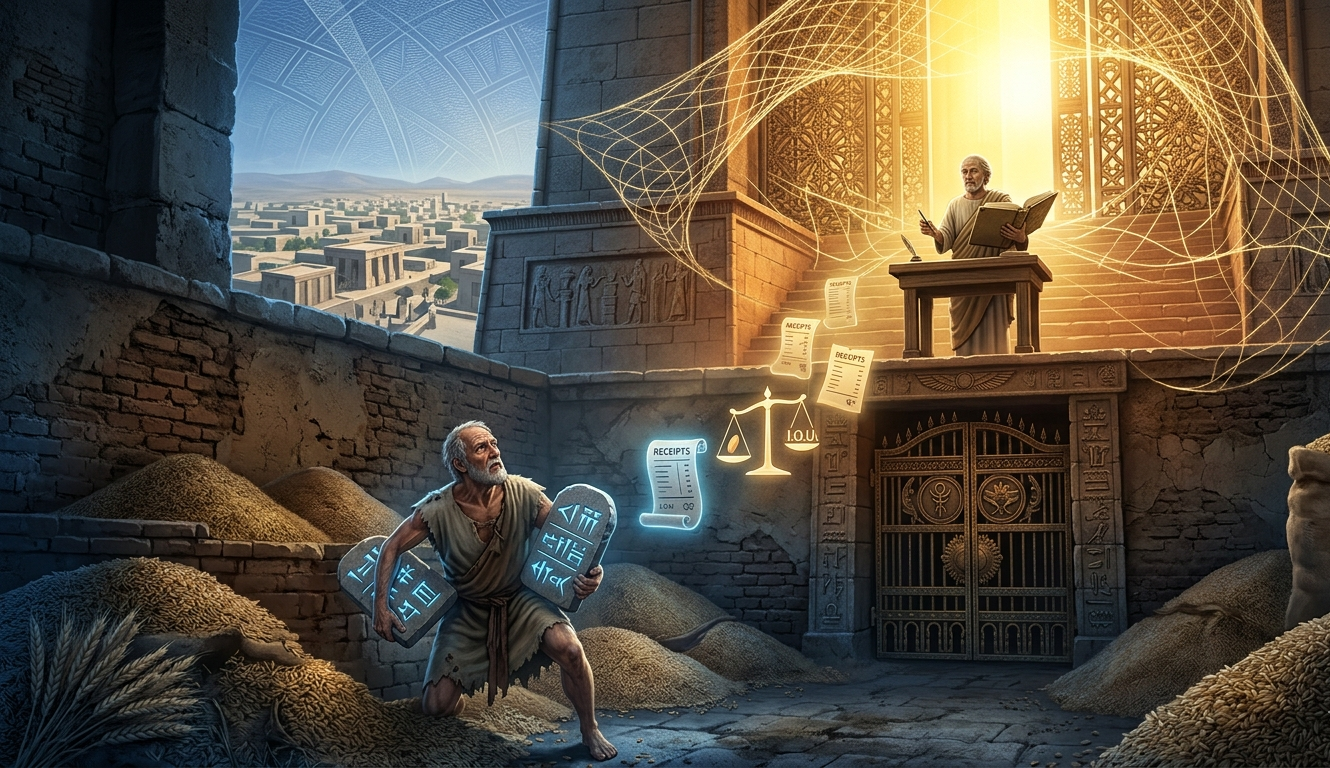
Everything so far has been physical. A body, a brake, a piece of ground, a mineral, a ration. Now the trap learns to work on something with no body at all, and once it learns this it never forgets, and the move it makes here is the one you will watch it make for the rest of the book in a hundred different costumes.
The first temples were not only places of worship. They were the first granaries, the first archives, the first banks, the first schools. The earliest writing we have recovered is not poetry or prayer.
It is accounting. Receipts. Records of who owed what grain to whom,
kept by the institution that sat at the center of the settlement and held the surplus that everyone’s survival depended on.
The first person who could read and write was an administrator of debt. The temple was the place where the food was stored, where the records were kept, where the future was rationed, and where, woven through all of it, the story was told that explained why this arrangement was not an arrangement at all but presumed to be “the order of the cosmos”.
Here is where the second pattern is born, and I want to name it precisely, because everything depends on getting this line exactly right.
The hunger that the temple answered was real. The awe was real.
The need to know why the river floods and why the child died and what happens after the last breath, this is the oldest and most human hunger there is. That hunger is older than the hunger for salt, and it does not deserve contempt.
I am not going to give it any. A person reaching for meaning is not a mark. They are a human being doing the most human thing.
The trap is not the hunger and it is not the answer.
The trap is the moment the answer is placed beyond testing, and the placing is done not to protect the sacred but to protect the arrangement that the sacred sits on top of.
When the story that explains the cosmos is also, conveniently, the story that explains why the surplus belongs to the temple and why the administrator’s hand on the granary is the will of heaven.
When asking whether that last part is really true gets you treated as someone reaching to pull down the cosmos itself, then the hunger for meaning has been found, occupied, and put to work.
The exit has been sealed. Not the exit from the faith. The exit from the question of who eats.
This is the blade this book will draw again and again.
A claim you cannot test, defended as though testing it were an attack, with someone growing fat on your agreement not to ask.
The hunger to believe is the oldest and most human thing there is.
A claim that forbids you from testing it is not feeding that hunger. It is farming it.
The word sacred reaches back to the Latin sacer,
and scholars have long noted that the root
carried a strange double charge: set apart for the gods, and set apart from ordinary touch, holy and untouchable at once.
Whatever the finer disputes about the word’s history, that double sense names the move exactly.
Set apart. That is the whole move in a single word.
The question of who eats is lifted up out of the realm where ordinary people are allowed to put their hands on it, and renamed as something too holy to handle, and the renaming is the seal.
> To the top of the ladder: what arrangement of yours have you wrapped in a story too sacred to question, and who would start asking dangerous questions the moment the wrapping came off?
>
> To everyone else: what have you stopped yourself from asking, not because you lack the courage, but because the asking was made to feel like a betrayal of something that once genuinely held you?