From The Witness
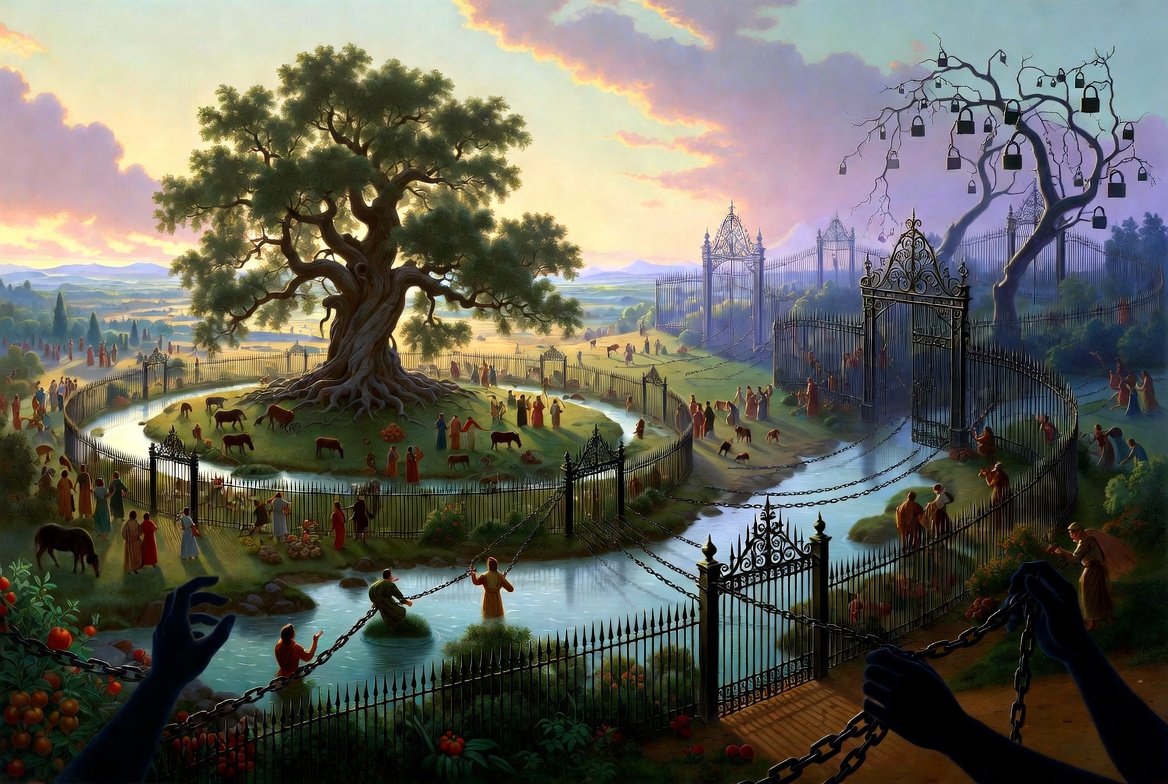
Before the enclosure there was the commons.
Not as a political idea, not as an ideology, but as a practical fact of daily life for most of the people who have ever lived on this planet.
The field that every family in the village grazed animals on.
The forest where everyone gathered wood and hunted.
The river where everyone fished.
The well that everyone drank from.
The seed saved from last year’s harvest that everyone could plant.
These were not charity. They were not gifts from a lord.
They were simply the shared inheritance of a community that had worked the same ground for generations and built.
The commons are through use and custom and memory, a set of arrangements that kept most people alive most of the time without requiring anyone to own the whole of it.
The commons were not perfect.
They required the kind of management that the later mentioned Maine fishing village describes: informal rules, shared memory of past collapses,
the slow friction of people who had to keep living next to each other keeping each other honest.
But the commons worked, across centuries and continents, as a way of holding the necessities such as land, water, fuel, food, in a form that did not require anyone to pass through a gate someone else controlled.
The body could get to the thing it needed without asking permission of a single pair of hands.
Then the gate was built.
In England between roughly the fifteenth and nineteenth centuries, a series of acts of Parliament converted common land into private property. This was at a scale that remade the entire social order.
The enclosure acts did not invent the private land claim.
That was already old.
What they did was apply it systematically, with the full force of law, to land that entire communities had depended on for generations, at a speed that gave no time for adjustment.
With compensation, when any was offered at all, that bore no relationship to what was actually being taken.
Families that had grazed animals on common land for longer than anyone could remember found themselves, very suddenly, trespassing on someone else’s property.
The common right had been real.
The enclosure was also real.
The law said one canceled the other, and the law had been written by the people who would receive the land.
The people pushed off the commons had to go somewhere.
They went to the cities, and to the factories the cities were building, and they arrived there with nothing, which is to say they arrived there with no alternative to whatever terms the factory offered.
The enclosure did not only take the land.
It manufactured the desperate workforce the industrial revolution required. By removing the option of subsistence that the commons had provided.
This is not a contested radical reading. It is what the historical record shows, and what later historians, studying the documents, have confirmed.
Now run the same move forward in time, because the enclosure of the commons did not end with the parliamentary acts.
The commons that have been enclosed in the centuries since are less visible but just as real.
The seed that farmers bred and saved and shared across ten thousand years of agriculture. That seed has been enclosed by the patent, so that the corporation that did the last mile of development owns what ten thousand years of collective human effort produced.
Now the farmer who saves seed from their own harvest is breaking the law.
There is knowledge produced at public expense in publicly funded universities. It becomes enclosed at the patent stage by the private entity that did the final step, so that the public pays twice.
Once to produce the knowledge and once to access it.
The folk song, the story, the game that children play, the cultural commons that every community generates freely and holds together.
It can all become enclosed by the copyright that extends and extends, now effectively permanent.
So that the shared inheritance of human expression is converted into a revenue stream.
The river and the aquifer, enclosed by the company that extracts the water and sells it back to the people who were drinking it free.
The radio spectrum, the wavelengths through which human communication travels, enclosed by auction and license so that the air itself becomes a revenue source.
The word common reaches back through Old French to the Latin communis, shared, belonging to all, from com, together, and munis, under obligation, bound to serve. The commons was the thing that belonged to everyone because everyone was bound to it and it to them. The enclosure move is the conversion of that mutual obligation into a one-way gate. The obligation to the community dissolves. The right to extract from the community survives. That asymmetry, community obligation removed and extraction right retained, is the oldest and most repeatable move in this entire book.
> To the top of the ladder: what commons, what shared inheritance that no single person built or earned, are you currently enclosing, and what story are you telling to make the taking sound like the adding of value?
>
> To everyone else: what was free before it was owned, what did you use to be able to reach without asking permission, and who is now holding the gate and calling themselves the provider?