From The Witness
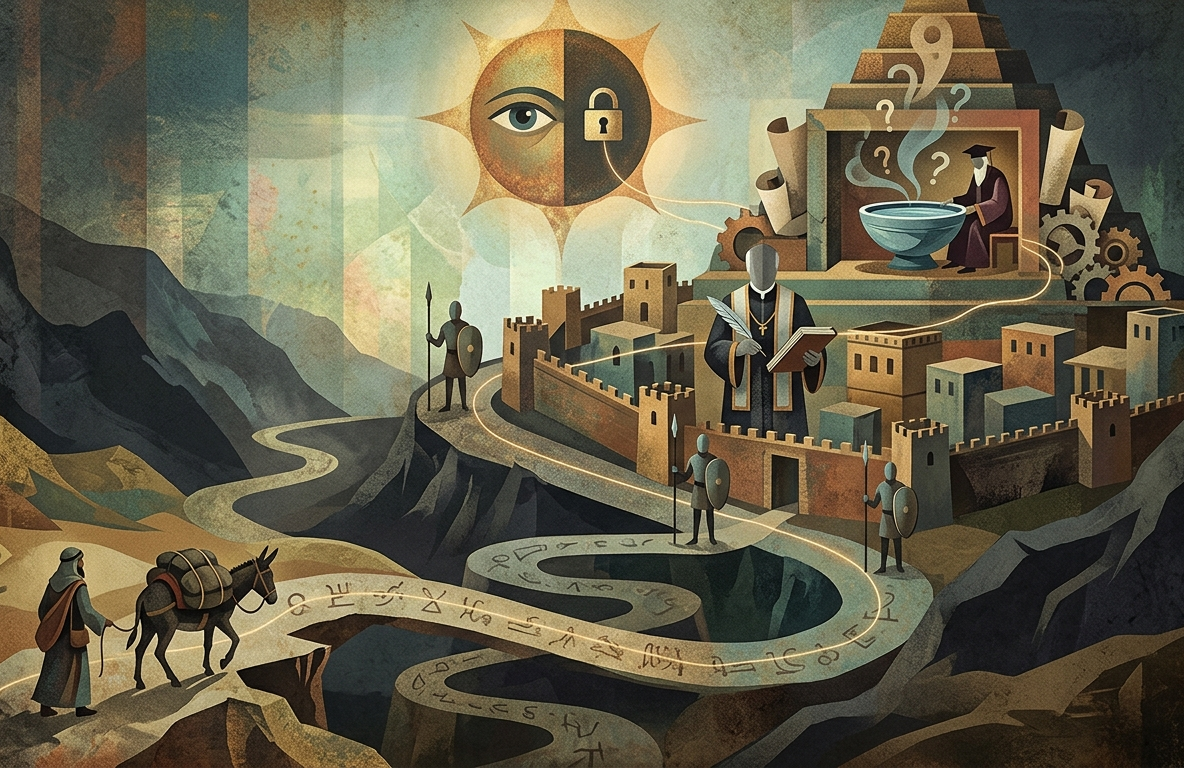
We are taught to picture the empire first and the trade second, the armies marching out and commerce following behind the safety of the sword.
The order is usually reversed.
The merchant goes first.
The trade route is laid down by people seeking profit.
Only once the route is rich enough to be worth protecting does the military arrive to protect it.
Then only once the military is there does the formal empire follow to administer what the military holds.
Once the empire exists does it build the schools to produce the administrators who keep the whole apparatus running.
Commerce is the spearhead.
Everything we call power is the shaft trailing behind it.
This matters for the book’s central claim, the one the prelude made and this movement is quietly proving: that the machine is older than any state and loyal to none.
The merchant on the ancient route belonged to no empire in particular.
He moved between them, carrying goods from a place that had them to a place that wanted them.
The merchants loyalty was to the moving and the margin, not to any flag along the way.
Mesopotamian traders reached the Indus valley.
Goods flowed between civilizations that had no diplomatic relationship and sometimes no knowledge of one another’s existence.
The network connecting them was not built by any king.
It was built by the appetite for profit finding the path of least resistance between supply and need, which is to say it was built by exactly the opportunism the prelude described, flowing downhill, taking what the absence of resistance allowed.
And the schools, when they came, were never neutral.
This is the thread worth following all the way to the present.
Classical Athens produced its philosophers because it was rich.
It was rich because it controlled the trade of the Aegean.
The leisure that allowed a man to sit and think about justice and the good life. That was leisure purchased by a surplus that other people, many of them enslaved, produced.
This is not a slander against philosophy; the questions those thinkers asked were real and some of their answers still hold.
It is an observation about the soil.
The first universities grew in the wealth thrown off by the trade routes.
They were tasked, among their nobler purposes, with producing the kind of person the network needed: the administrator, the scribe, the lawyer, the man who could keep the accounts and justify the arrangement in the same breath.
Education and the management of surplus have been the same institution, serving overlapping purposes, since the temple.
The school teaches you to read.
It also, quietly, teaches you which questions are worth asking and which ones mark you as a troublemaker.
> To the top of the ladder: which road that you now defend with great seriousness was laid, long before you, by someone who simply wanted the margin, and what story do you tell to make the defending sound like something nobler than guarding a route?
>
> To everyone else: whose surplus paid for the lessons that taught you what to think, and which of the questions you have never thought to ask were left out of those lessons on purpose?