From The Witness
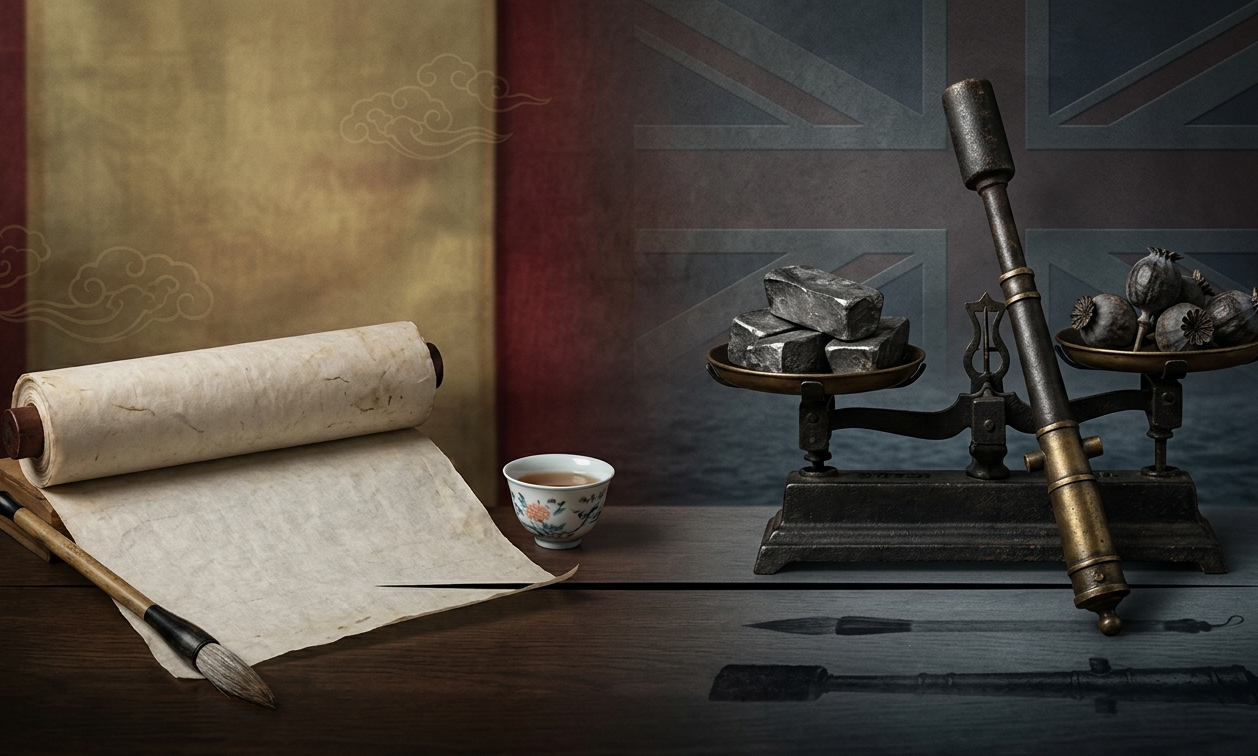
In the late 1830s, a senior official of the Chinese empire named Lin Zexu was given the job of stopping the opium trade that was hollowing out his country.
Opium was pouring into China by the ton, carried largely by British merchants.
They used the profits to balance their own trade: Britain wanted Chinese tea and silk, China wanted little that Britain made, and the gap was closed by getting a growing share of the Chinese population addicted to a drug. Lin took the job seriously.
He seized and destroyed enormous quantities of the drug, more than a thousand tons of it, in public, on the beach.
And he did one more thing, which is why he belongs in this book.
He wrote a letter to Queen Victoria.
In it he made an argument so simple and so devastating that it has never really been answered, only ignored.
He pointed out that opium was banned in Britain itself, because the British understood perfectly well what it did to people.
And then he asked the question that sits at the dead center of everything this book is circling.
He wrote, “Suppose that people from another country carried opium into England and set about seducing your own people into smoking it. Would you, the sovereign of that country, not look upon it with fury and move to stamp it out?”
That is the oldest moral rule there is, the one about doing to others as you would have done to you.
Spoken plainly, in an official document, by the representative of one empire to the monarch of another.
Do not do to my people the thing you have made illegal to do to your own.
It is unreasonable on its own terms, and everyone involved knew it was unreasonable, and it did not matter in the slightest.
The letter, by most accounts, never even reached the Queen.
What reached China instead was the Royal Navy.
Because when the moral argument was made and could not be refuted, the response was not to refute it.
The response was force.
Britain went to war, twice, to keep the Chinese market open to a drug, and won.
Then Britain imposed terms that pried the country open and humiliated it for a century.
This is not a contested radical reading of the events.
The British Army's own museum, describing these wars to the British public, acknowledges plainly that they were fought in the interest of the opium trade.
A war on behalf of drug smugglers.
The empire's own institution says it.
Hold the shape of this against the prelude.
A moral claim is made.
It is true.
It cannot be answered.
And it changes nothing, because the thing it is addressing is not a person who can be shamed but a machine that takes what it can.
And what the machine could take, in that moment, was a whole nation's market for a poison.
Defended by the most powerful navy on earth.
The golden rule, spoken aloud into the record, met the gunboat, and the gunboat won.
Remember that when we get to the hopeful parts of this book, because the hope, when it comes, will have to be built in full knowledge of this: that being right, by itself, against a machine that meets no resistance, has never once been enough.
> To the top of the ladder: what market are you defending right now that you could not defend out loud, in plain words, to the people it harms, and what is your version of the gunboat for the moment the plain words are spoken?
>
> To everyone else: when someone has made the unanswerable argument on your behalf and been answered with force, where did you look, and did you tell yourself the force was something other than what it was?