From The Witness
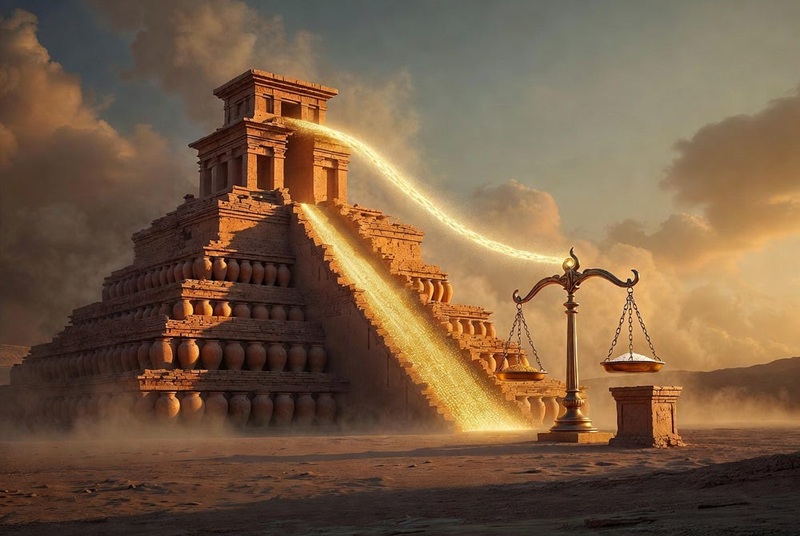
Strip the banner off any coup and ask one question:
Who controls the surplus when the dust settles.
Ask it of every usurpation in the record, the dynastic, the religious, the patriotic, or the liberating.
The answer is the same kind of answer every time, because a seizure of power that does not change who controls the surplus is not worth the risk of staging.
Whatever a coup says it is about, it is a transfer of the granary.
The banner is the costume.
The surplus is the prize.
Which means the merchant is never far from the usurper, and never has been, because the merchant is what the usurpation is for.
Whether or not his is the hand on the knife.
But this is not a story that starts with the coup.
It starts much earlier, at the moment when there was first something worth taking.
Once you understand that moment, the coup is not a dramatic event in the story.
It is the inevitable end of a progression that was already running long before the first army moved.
Before the surplus, there is nothing to usurp.
A band of thirty people following game and gathering roots has no granary, no accumulation, nothing that concentrating power would get you.
The coup is an impossible concept in the absence of a storable surplus, because power over a hundred pounds of meat that must be eaten before it rots is power over almost nothing.
The technology that changed everything was not the sword or the siege engine.
It was the clay jar.
The ability to store grain across seasons, to accumulate more than any group could consume before it spoiled, created, for the first time, a thing worth taking.
And the moment there was a thing worth taking, there were people thinking about how to take it, and how to make sure no one took it from them.
The granary is where social law begins.
The first granaries were communal, managed by the group for the group, the original commons.
But communal management requires everyone to agree on the rules of access, on how much each person may draw and when and on what grounds.
That agreement is always in tension with the possibility that someone with more information, more reach, more social authority, could draw more than their share and prevent the questioning of it.
The temple arrived as the solution to this coordination problem:
a permanent institution that held the surplus, kept the records, and adjudicated claims.
It was a genuine solution and it served real needs.
It was also, from the very first day of its operation, the most powerful position in the settlement.
Whoever administered the granary decided who ate and who waited.
The priest and the merchant were not competing roles that later got mixed together.
In the earliest Mesopotamian cities they were functions of the same institution, the same building, and often the same person.
The administrator who controlled the grain ration was the first treasurer, the first creditor, and the first official who needed a story about why this arrangement was just.
So the commercial interest did not arrive at the throne late, as an outside corrupter of some cleaner original politics.
It was the politics, from the moment the surplus was large enough to be worth governing.
When the lugal, the big man, the king, emerged in Mesopotamian cities, he did not replace the temple.
He grew up alongside it, in a relationship that was always partly competitive and always partly commercial, each needing what the other controlled.
The king needed grain to feed soldiers.
The temple needed soldiers to protect the granary.
The relationship was transactional before it was constitutional, and the transaction shaped everything that followed.
Now the moment the record first becomes visible, and I want to be precise about what the visibility tells us.
The dark stretch is real and the book's discipline holds here harder than anywhere else.
The earliest throne changes reach us almost entirely through the winners' inscriptions, and the winners wrote in the language of heaven:
the gods chose me,
the mandate passed,
the old king had lost the favor of the cosmos.
We cannot see who financed the first usurpers, because the inscription is the seal itself, built precisely to bury the question of who paid under the answer of who was ordained.
I am not going to invent a Babylonian grain cartel the tablets do not show.
I am going to say the more careful and more damning thing:
the unseeability is not an absence of the pattern.
It is the pattern's oldest piece of work.
There is a further observation that the deep dive into the record produced: the places in the historical record where the merchant is most invisible are the places where the arrangement was most complete.
Where the seal held best.
Where the cover story was so early and so thorough that nothing needed to be suppressed.
Because nothing was ever going to be asked.
The history you can see is the history the machine failed to fully seal.
The history you cannot see may be denser, older, and more pervasive.
The visible edge of the pattern is not the pattern.
Hold that the whole way through what follows.
Where the seal slips, the merchant is standing exactly where the structure predicts.
And the record slips early in a way that shows not the coup but the stage before the coup, which is the stage the whole progression runs through first.
By the time writing is four hundred years old, merchant organizations in Mesopotamia are already operating.
They have their own legal institutions, their own contract law, their own enforcement mechanisms.
The tamkārum, the merchant class of the Old Assyrian period, was not a guild of tradesmen tolerated at the king's pleasure.
It was a commercial entity with its own courts and its own records, operating in formal treaty relationships with the thrones of Anatolia.
Tax privileges written into bilateral agreements, the merchant colony's legal status recognized and guaranteed by the local ruler.
Because the local ruler needed what the merchant colony provided.
Four thousand years ago, beside the cities of Anatolia.
Assyrian merchants ran formal colonies with their own courts and their own law.
Twenty-three thousand tablets survive from a single colony at Kanesh.
They are not the records of people who existed at the king's sufferance.
They are the records of a commercial power that sat at the treaty table as a contracting party alongside the throne, not subject to it.
This is the first documented stage, and it is important to feel what it means for the progression.
Merchant power was not waiting to be born in some later mercantile age.
It was already organized, already legal, already seated at the table where thrones made terms, almost as far back as writing reaches.
The throne and the commercial institution had been co-evolving for long enough that by the time we can see them they are already fully developed partners.
And the partnership was shaped, from its earliest documented form, by a mechanism the book has not yet named in this context:
debt.
The king who borrows from the merchant house will acquire in that transaction a structural dependency.
He cannot easily act against the merchant house without destabilizing his own financing.
He cannot antagonize the trading colony without losing the silver and tin and textiles that his court and his armies require.
The debt is the leash, held loosely most of the time, felt only when the merchant's interests are directly threatened.
The karum tablets document not only commercial transactions between merchants but loans extended to palace officials, credit relationships that crossed the line between trade and governance.
The commercial institution did not control the throne through corruption or conspiracy.
It controlled it through the ordinary mechanics of credit and dependency.
The same mechanics the mortgage post described, now applied not to a family but to a state.
The throne that owes money behaves differently from the throne that does not.
In the direction of the creditor's interests, without any dramatic moment of capture and without any single act that could be called a coup.
This is the mechanism that makes the coup mostly unnecessary throughout most of history.
The coup is expensive, dangerous, uncertain, and leaves evidence.
The credit relationship is cheap, deniable, self-reinforcing, and looks exactly like ordinary commerce.
Most of the time, for most of the pattern's history, the throne was not seized.
It was indebted, dependent, and directed.
The directing was so thoroughly built into the normal operation of the economy that neither party would have called it anything other than business.
Then watch what happens when conquest arrives and encounters the same logic from the other direction.
The Mongol conquests were not merchant coups.
They were the work of a steppe military aristocracy, and the book will not pretend otherwise.
But what the Mongols discovered after conquest is the turn that reveals the pattern's deep logic:
the raid produces less than the toll.
Destroying the trading city gets you one payment.
Protecting it and taxing it gets you payments forever.
The Mongols secured the Silk Road, protected the caravans, and established themselves as the wall and the toll gate on the greatest trade network the world had yet seen.
What began as pure conquest became, within a generation, the protection racket that commerce had always needed and had always been willing to pay for.
The conqueror and the merchant arrived at the same position from opposite directions, because the surplus logic pulls everything toward the same configuration:
whoever can guarantee the flow of goods and extract a fraction of the flow is sitting in the most durable seat power has ever built.
By the thirteenth century, the credit relationship had learned to steer armies it had never raised.
The knights of the Fourth Crusade arrived in Venice having ordered a fleet they could not pay for, and the Doge converted their debt into direction: first against Zara, a Christian port that had slipped Venetian control, then, by the compounding logic of debt and obligation and the need to fund the next stage with the gains of the last.
The whole expedition ended by sacking Constantinople, the greatest commercial prize in the eastern Mediterranean.
Historians have long called it the Commercial Crusade.
The army wore the cross.
The debt held the rudder.
No Venetian needed to swing a sword to aim ten thousand of someone else's.
This is the credit relationship matured into something new:
not the throne dependent on the merchant house, but the army itself dependent, redirectable, available for deployment against the merchant's actual objectives while believing it was serving its own.
In 1757 the stages fused into something the world had not quite seen before, and would not see surpassed until the corporation learned to shed the army entirely.
At Plassey, the East India Company, a trading corporation with its own army, entered into conspiracy with the Jagat Seth banking house, indigenous Bengali financiers whose commerce ran on British silver and who had soured on a Nawab hostile to British trade.
Together they bribed the commander of the Nawab's own army, guaranteed him the throne in exchange for his betrayal.
On the day of battle he held his troops idle while the Company's smaller force destroyed the remaining defenders.
The Nawab fell and fled and was executed.
The commander was installed as a client on the throne he had sold.
Within eight years the Company held the diwani, the right to collect the tax revenue of Bengal, for its shareholders in London.
The conquest was settled by contract before the cannon confirmed it.
Underwritten by indigenous bankers whose interests crossed every line the nationalist story wants to draw cleanly.
The merchant was on both sides of the stroke, foreign and domestic.
Coordinating across the boundary that would later be called colonizer and colonized.
Because the surplus logic has never respected the national lines drawn on top of it.
Then the corporation learned to shed the army, because armies are expensive and the host nation has one already.
In January 1893 a Committee of Safety formed by the sugar planters and financiers of Hawaii deposed Queen Liliuokalani, and the force that made resistance impossible was not theirs.
It was the United States Minister and the Marines he landed from a warship in the harbor.
The host nation's military deployed in the commercial interest's service.
The cost socialized to the public, the gain remaining private.
The queen yielded under protest.
A planter was installed as president.
The American investigation that followed found the overthrow illegal.
Nothing was restored.
A century later the United States Congress passed a formal apology, and that resolution, the government's own document, names the deposing party in the government's own words:
the sugar planters,
the descendants of missionaries,
and the financiers.
You do not need to infer the merchant's presence.
The government named him.
And the man who carried that arithmetic abroad for three decades across Central America and the Caribbean wrote the confession himself, in print, in 1935.
The most decorated Marine of his era named his employers:
the oil interests in Mexico,
the National City Bank boys in Haiti and Cuba,
the International Banking House in Nicaragua,
the sugar interests in the Dominican Republic,
the fruit companies in Honduras.
Country by country, intervention by intervention, he traced the line from the commercial interest to the military action and called it what it was:
a racket, and himself a gangster for capitalism.
The enforcer named the merchants he enforced for, and that document exists, and the next posts in this movement stand on it.
The final stage is the one this book has already mapped from the other direction.
Where the room before the room works.
Where the donor filter holds, the throne need never be toppled, because it is staffed upstream before anyone votes.
The coup becomes the fallback, the expensive option reserved for the countries where capture failed.
Which is why the modern cases ahead cluster in countries that tried to redirect their own surplus toward their own people.
The merchant beside the throne no longer needs to change the king.
He needs only to be the kingmaker.
Every stage of this progression,
the granary creating the incentive.
The temple fusing commerce and power.
The credit dependency built into the throne before any army moves.
The debt that steers.
The corporation that finally combines capital and force in a single legal body.
The borrowed national army that socializes the cost and privatizes the gain.
They all required the same precondition:
a single throne, a single neck, one chokepoint where the surplus is controlled and can therefore change hands in a night.
A surplus held in common, by many hands that watch each other, has no such neck.
It never has.
That is not a metaphor for resistance.
It is the design specification for the only arrangement this whole progression has never once managed to seize in a stroke.
Which is why the machine has spent equal energy across all these centuries ensuring that such arrangements are either enclosed, discredited, or priced out of existence before they can become the default.
The word usurp comes from the Latin usurpare, to seize for use, from usus, use, and rapere, to seize.
The language admits what the banners deny.
The seizing was always for the using, and the using was always of the surplus, and the surplus was always in the granary, and the granary was always the building where the commercial interest and the political power first learned that they were the same thing.
> To the top of the ladder: which changes of management, in your industry or your country or your office, have you financed or welcomed under some nobler banner, and what did you control after them that you did not control before, and how closely does that answer match the banner you flew?
>
> To everyone else: the last time the power above you changed hands, under whatever flag it happened, who controlled the surplus afterward, and did you ever go back and check whether the answer matched the story you were told at the time?