From The Witness
The previous post traced who coups are for.
This one is about why they work.
Because by every honest count they should not.
A few hundred people, sometimes a few dozen, capture a state with millions of citizens.
The arithmetic never favors the plotters.
Something else does, and naming it is the beginning of disarming it.
A coup is not a military victory.
It is a coordination trick.
It does not defeat the population, because it cannot;
the population outnumbers it absurdly and always has.
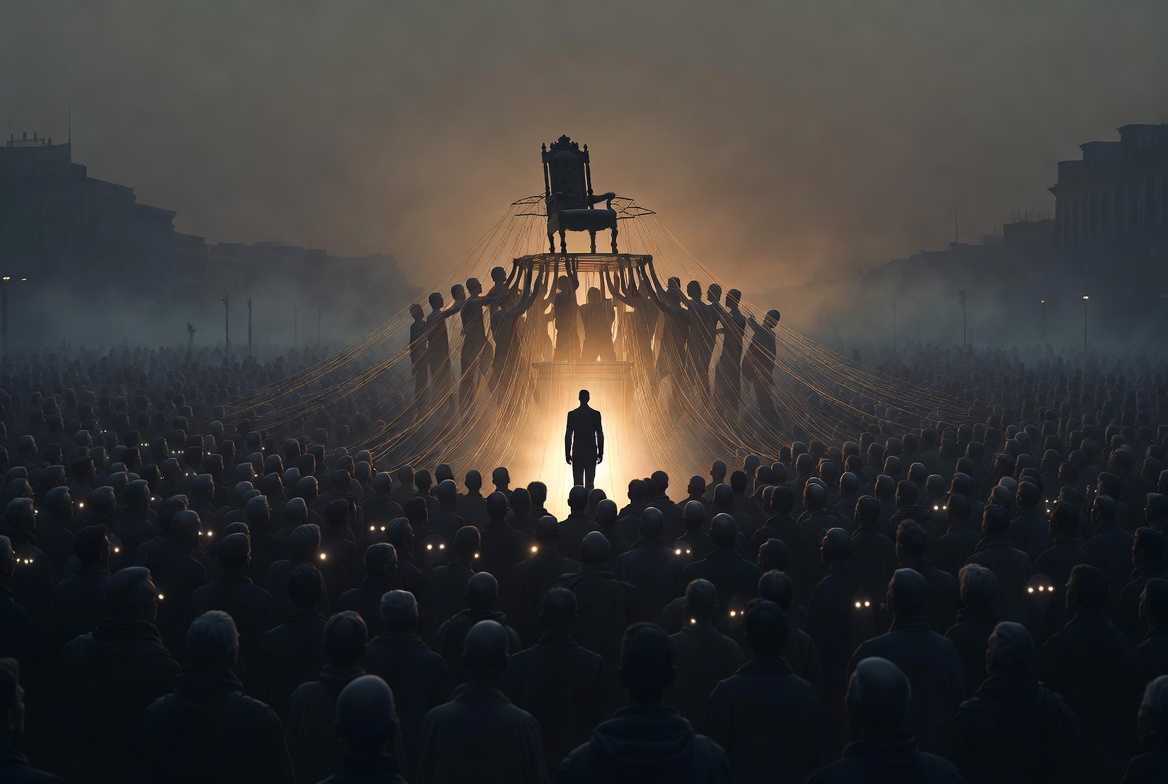
What it does instead is manufacture, in a single compressed stroke, the impression that everyone else has already accepted the new arrangement.
Seize the visible center, the palace, the broadcast tower, the square.
Declare the matter settled.
Then deploy the actual weapon, which is the waiting.
Each person, alone, watches to see what everyone else will do.
Each person's stillness reads, to every other watcher, as consent.
And the consent becomes real because it was read as real, by everyone, about everyone, simultaneously.
Nobody submitted.
Everybody waited, and the waiting was the submission.
This is not new machinery.
It is the watchers watching each other and the seal.
The two oldest tools in this book, compressed into seventy-two hours:
an untestable claim; “we have already won”, defended by the crowd's own silence.
Now each member of the crowd is enforcing it on the others simply by failing to move first and ask questions.
That is why the plotters' first act after the stroke is never consolidation of force.
It is the manufacture of normalcy.
The broadcast that says the situation is calm.
The constitutional fig leaf such as the judge found at midnight to administer some oath.
The legislature summoned to ratify what it cannot refuse.
The plotters must quickly turn the shock of their sudden takeover into the dull weight of inevitability before the public snaps out of its daze.
They are racing a clock; the illusion of their total victory has a strict expiration date, and everyone in the room knows it.
Time is the cheapest legitimacy there is; the book said that at the very beginning.
The coup's whole first week is an attempt to start that clock.
And because the trick is a trick, it has a documented failure mode.
The cleanest case in the record happened inside the current host.
In 1933 and 1934, agents acting for a circle of financiers approached Smedley Butler.
The most decorated Marine alive, and they met him with a proposal:
lead an army of five hundred thousand veterans on Washington and reduce the elected president to a figurehead.
They chose him for exactly the reasons the previous post laid out.
He had spent three decades being the borrowed army.
The muscle behind the fruit companies and the banks.
The organizations assumed the enforcer they had aimed abroad for a generation could be aimed home.
They misread their man.
He played along just long enough to gather evidence, then took the whole thing to Congress under oath.
The committee that investigated concluded in its final report that the plan had been discussed and prepared, and could have been set in motion whenever the men funding it judged the moment right.
No one was prosecuted.
The book has heard that one before; they do not hang bankers.
But look at precisely where the coup died: at the recruitment stage, before any fact could be accomplished, because the one man the trick required refused early, refused publicly, and put the refusal on the record where the whole country could see it.
The impression of inevitability never formed, so the waiting it needed never began.
That is the resolve, and it generalizes.
The generalization is documented across every failed coup in the modern record.
The trick requires that each person, watching alone, believes everyone else has already yielded.
It is broken by anything that makes refusal visible before the impression can set:
the streets that fill immediately rather than after a prudent pause,
the broadcaster who keeps transmitting,
the soldiers who look at the crowd and discover the population has not in fact submitted and begin disobeying,
the general strike that makes the country ungovernable inside the window the plotters needed for the clock of normalcy to start.
None of that can be improvised at three in the morning while the tanks are at the station.
It is prepared in calm, like the drawer in the shock doctrine post:
The illusion only works if people are caught off guard and isolate themselves to wait and see what others do.
It completely fails against a population that has already agreed, out loud and in advance, on a single boundary: *we will never obey a government taken by force.*
Because they drew that line during peacetime, nobody has to wait to see how their neighbor will react during a crisis.
They already know.
Beneath the immediate defense sits the deeper defense from the previous post.
The stroke requires a neck.
A commons.
The surplus held and watched by many hands together.
With no single visible center whose seizure settles anything.
The commons offers the trick nothing to seize and no impression to manufacture.
You cannot declare an accomplished fact over ten thousand granaries run by the people who fill them.
The phrase coup d’état is French and means a stroke of state, a single blow.
The phrase is a confession.
A stroke needs a neck.
Power that has no single neck cannot be taken with one blow, and everything this book has said about the collective brake is also, it turns out, a description of the only architecture that has never been decapitated.
> To the top of the ladder: how much of your security rests on the people below you each privately believing that everyone else has already accepted you, and what happens on the morning enough of them discover, all at once and out loud, that the acceptance was an impression and never a fact?
>
> To everyone else: if the accomplished fact were declared tomorrow, would you wait to see what your neighbors do, and do your neighbors know whether you would wait, and what would it cost the trick if all of you decided together, now, in calm, that none of you will?