From The Witness
The book has described the machine's management of chronic alarm:
the steady drip of threat and outrage that keeps the brake too tired to do its work.
This is not that.
This is the acute shock, the thing that disables the brake.
Not gradually but all at once.
Across an entire population simultaneously.
This is what the machine learned to do with the interval before the brake comes back online.
A depression. A pandemic. A terrorist attack. A financial collapse.
The specific content of the shock matters less than its structure:
in the moment of acute crisis, the collective ability to weigh and deliberate and resist is suspended.
Not worn down but switched off, because the body under genuine immediate threat does not have the metabolic budget for anything but the threat.
This is the fight-or-flight response at civilizational scale.
Everyone's alarm is running simultaneously.
Nobody has the bandwidth to read the legislation.
That interval, between the shock and the recovery, is the most valuable real estate in the history of extraction.
Naomi Klein documented the pattern across the second half of the twentieth century and named it the shock doctrine:
the systematic use of crisis, real and sometimes manufactured.
To advance enclosures that the population would never accept in ordinary times.
Pushed through while the population is reeling and cannot organize to resist.
The Patriot Act passed six weeks after the September 2001 attacks.
Over a thousand pages of law that fundamentally restructured the relationship between the state and the private lives of its citizens.
Moving through a legislature whose members admitted afterward they had not read it.
The 2008 financial crisis, a genuine disaster caused in significant part by deregulation the machine had spent decades engineering.
The outcome was resolved through measures that socialized the losses and privatized the gains.
Transferring enormous wealth upward while the population was too frightened and too confused to mount coherent resistance.
These are not contested interpretations.
The documents exist.
The votes are on record.
The timing is not subtle.
Look at the structure.
The crisis arrives, real or amplified or occasionally engineered.
The population's collective brake disables.
The machine moves the walls.
The legislation is written in the emergency session.
The executive order is signed.
The contract is awarded.
The surveillance infrastructure is built.
And by the time the panic releases and the population's deliberative capacity begins to return.
The new enclosure is already written into law.
Into habit.
Into the infrastructure of daily life.
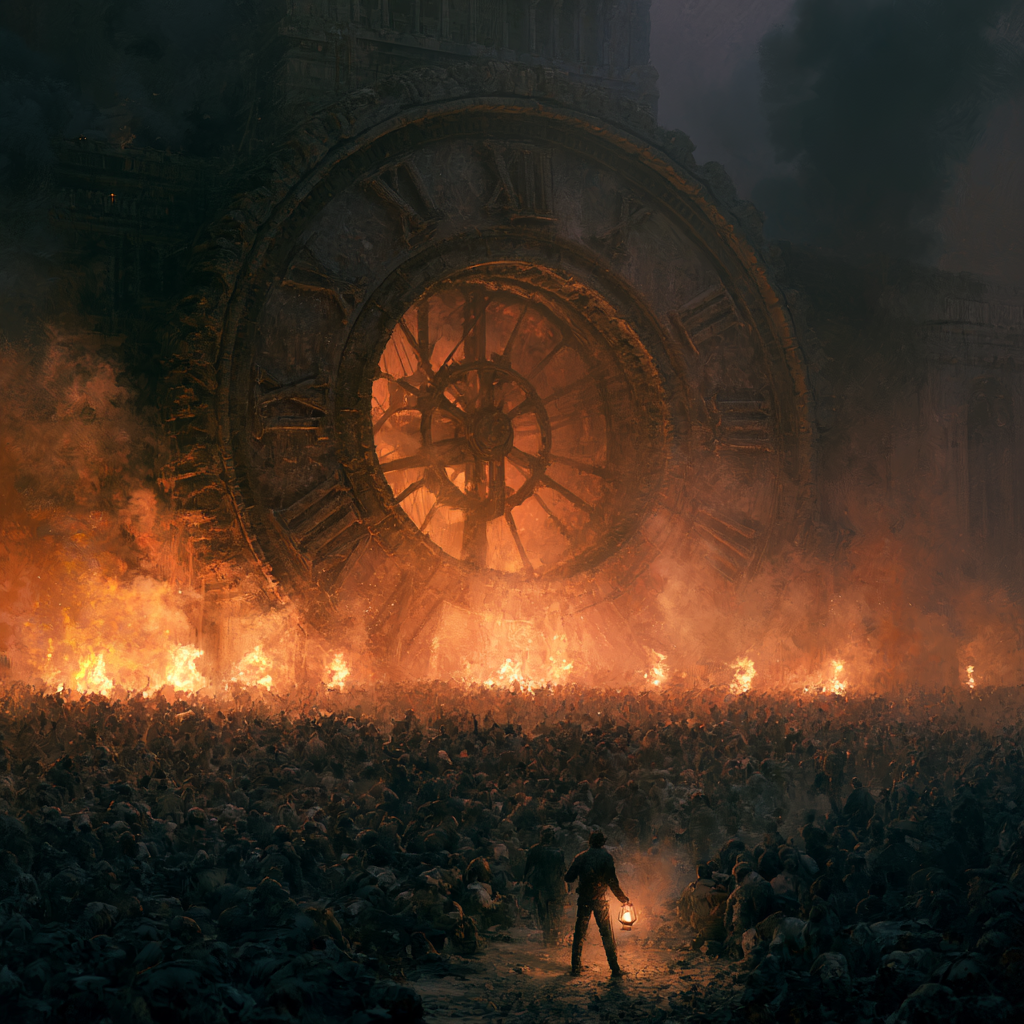
It does not feel like a wall because it was installed while everyone was looking at the fire.
The wall looks like the landscape because it was built before anyone had the capacity to ask whether it should be there.
And here is the resolve, because the same record that documents the move documents the counter-move, and the counter-move works by the same mechanism in reverse.
The reason the machine's enclosures are the ones that get installed during a crisis is that they are the plans already written.
Sitting in the drawer, ready for the moment the brake disables.
The crisis does not invent the enclosure.
It opens the window for a plan that was prepared in advance.
Which means the friction is also a plan prepared in advance,
the alternative already written, already argued, already waiting.
So that when the window opens it is not only the extractive plan that is ready to move through it.
Klein documented both halves:
Klein showed that during a crisis, the communities that avoided being taken advantage of were the ones that had already prepared a backup plan. Because they did that hard work in advance, they had a real alternative ready to use the moment the emergency hit.
Instead of being forced to accept the harmful policies pushed by those in power.
The work is done in the calm, for the crisis that has not yet come.
The community that has already written its own emergency plan.
The cooperative that has already drafted its charter.
The movement that already knows what it will demand the day the window opens.
Those are the only things that has ever turned a shock away from extraction and toward repair.
The preparation is the resistance.
It has to be finished before the fire, because during the fire there is no time to write anything, only time to reach for what is already written.
The word crisis comes from the Greek krisis, a decision, a turning point, from krinein, to separate, to decide.
The crisis was always the moment of decision.
The machine's genius was to ensure that by the moment of decision, the people most affected by it were in no condition to decide anything.
> To the top of the ladder: which crises, real or amplified, have you used as cover to move a wall into territory you could never have claimed in ordinary time, and what would have happened to that claim if the population had been given the bandwidth to read it?
> To everyone else: which of the walls you are currently living behind was built during a crisis you were too frightened to examine, and what would it cost you to read the legislation now, years after the emergency that justified it has passed?