From The Witness
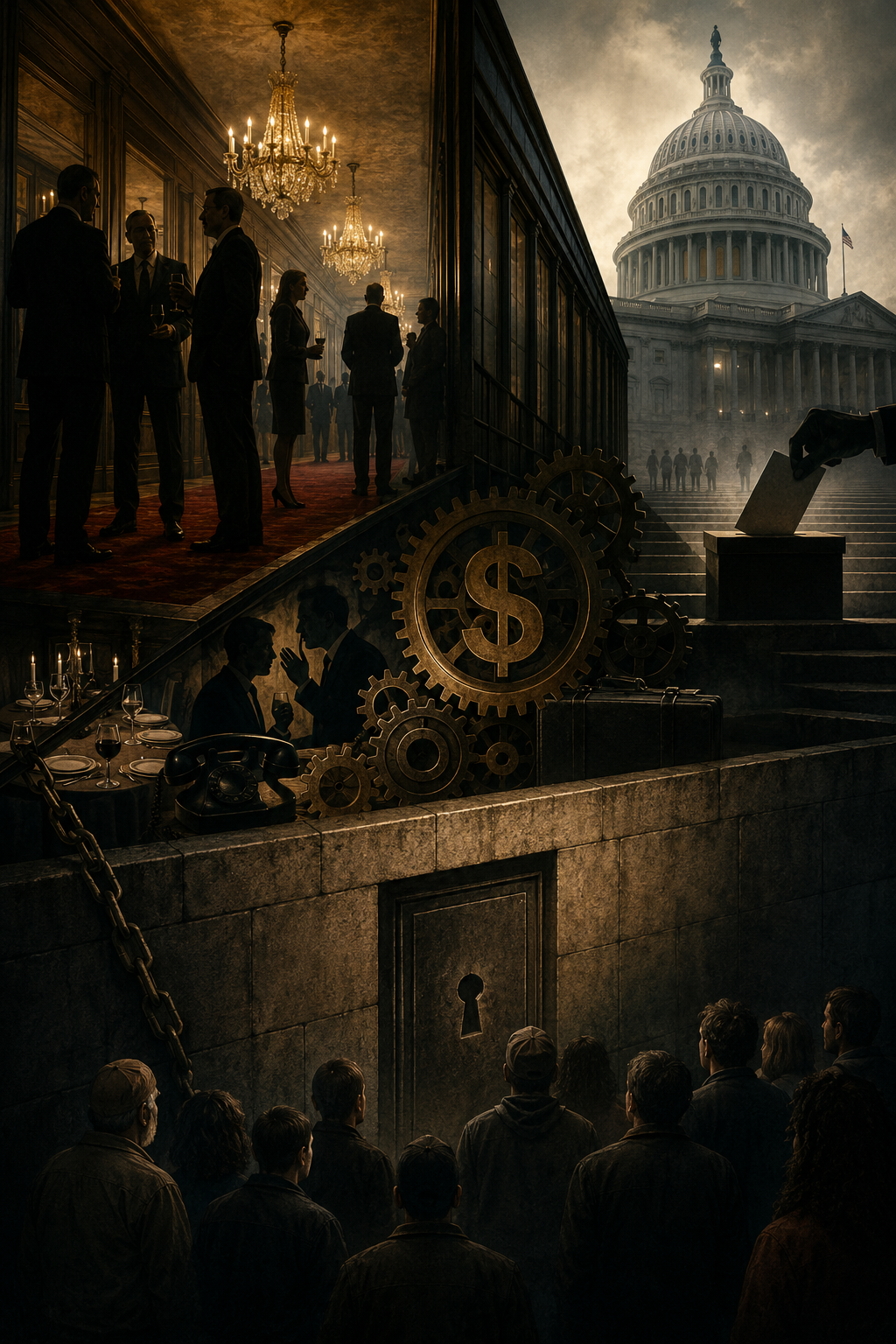
The story comes home now.
Into the present.
Into the place where the machine does its work in broad daylight and calls it democracy.
For this stretch the examples are mostly American, and I want to say once, plainly, why.
Not because these patterns are American.
They are not.
They run through every system with enough wealth to be worth capturing, and they are documented across the whole political spectrum.
The examples are American because America is the current host.
Which means it is where the machine's present-day methods are running at the largest scale and in the most visible form.
I am not naming a party.
There is no party that lives outside the building.
I am naming the architecture, and every party lives in it.
Before the vote there is the room where the vote happens.
And before that room there is an earlier one:
the hallway,
the dinner,
the fundraiser,
the phone call,
the quiet conversation that decides what the vote will even be about and which options will be on the table before any official ever raises a hand.
That earlier room has a polite and protected name.
It is called lobbying, and lobbying, in its bare form, is a genuine right.
Petitioning your government is old and real and worth defending.
Which is exactly what makes it such excellent cover.
The seal here is built from honorable words:
speech, participation, advocacy, access.
The wall those words are wrapped around is simple.
The vehicle is money, and the thing money buys is not usually a vote, which would be crude and illegal.
What money buys is the closeness, the access, the early seat in the room before the room, where the shape of the possible is decided.
Two documented facts mark the outline of it.
In 2010, in the case known as Citizens United, the Supreme Court held that independent political spending was a form of protected speech that could not be capped.
Opening the door to effectively unlimited money flowing into the machinery of elections.
And the one law specifically built to drag foreign influence over American politics into the daylight, the Foreign Agents Registration Act, was found by the Justice Department's own inspector general in 2016 to have been barely enforced for half a century:
between 1966 and 2015, only seven criminal cases were brought under it.
After that audit, enforcement did increase, which is worth saying plainly so the picture stays honest.
But for fifty years the law that was supposed to make foreign influence visible mostly mailed polite letters asking people to please register.
Now the honest correction, because this is exactly the kind of place the book is at risk of overreaching.
The hallway is tilted, not sealed.
It is priced, and the price sorts who is standing in it by default.
But it is not locked, and pushback exists, and pushback sometimes wins.
What I can defend is the narrow, sturdy claim.
The structure tilts toward the people who can pay for access.
So the same narrow interests tend to be in the room before the room as a matter of course, while the broad public gets in only on the rare occasions it organizes hard enough to force the door.
Show me the public standing in that hallway by default, funded and organized and present every single day the way the lobbyists are, and this post is wrong.
> To the top of the ladder: who is always already in the room before the room when your decisions get shaped, and who is never in it, and how much of your outcome was settled before the public part even began?
> To everyone else: who is standing in the hallway outside the decisions that govern your life, every day, by default, and is there anyone in that hallway standing there for you?