From The Witness
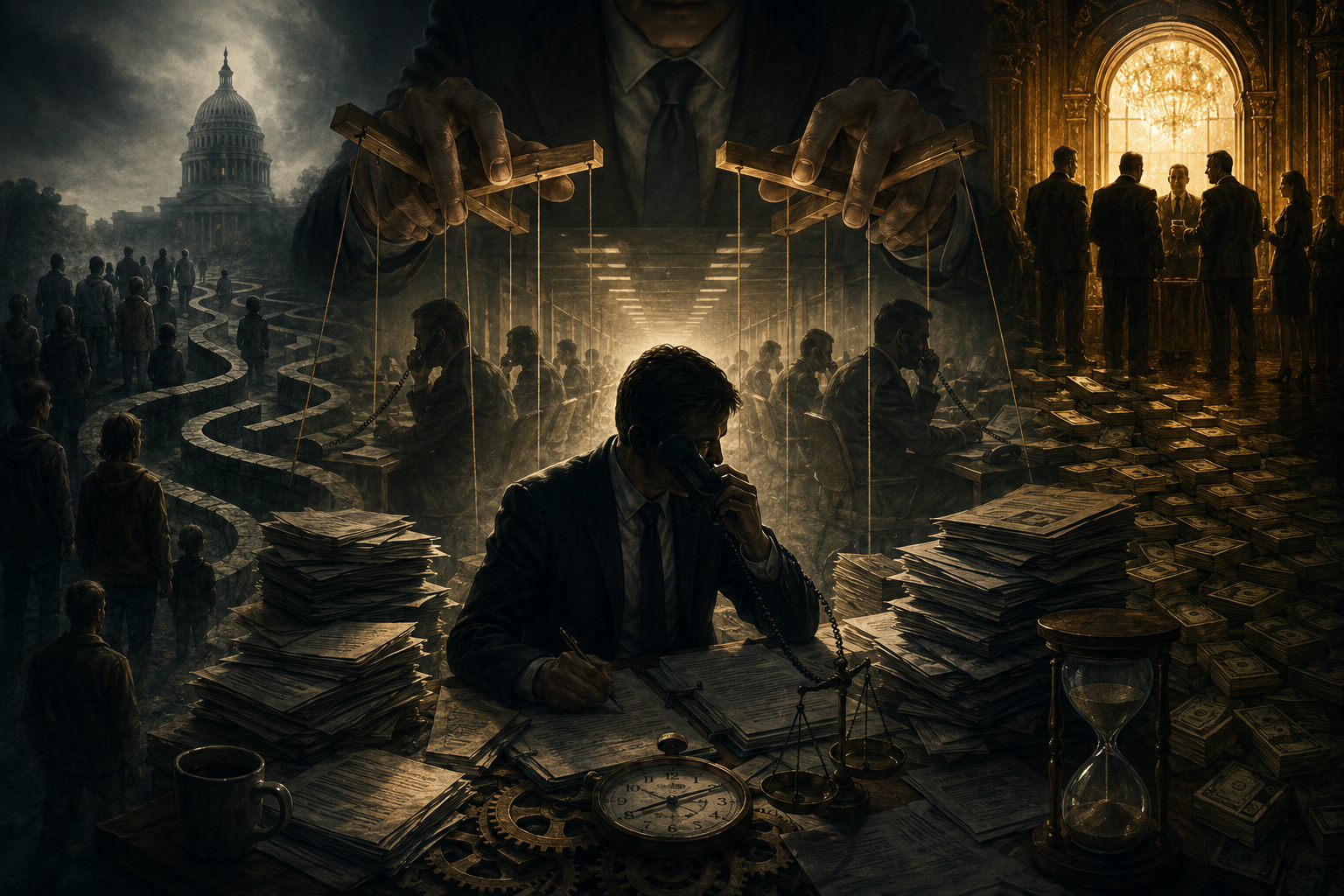
Picture a person who has just won an election.
Someone who ran because they believed something.
Someone who arrives ready to do the work.
Someone who discovers, fast, what the work actually is.
Not the votes on the floor.
The phone.
Hours of it, most days.
Calling people who can give money, because the next election is always coming and always costs more than the last one did.
This is not corruption in the cartoon sense, and it is important to be precise about that.
The cartoon version, the bag of cash in the parking garage, is rare and mostly illegal and lets everyone feel clean by comparison.
The real thing is quieter, legal, and far more effective.
It is a structure that decides, in advance, where a person's attention is permitted to go.
Hold the part that is firmly documented.
Political money in the United States comes overwhelmingly from a very small slice of the population, a measured concentration, not a slogan.
The cost of running for and keeping a seat has climbed steeply over decades.
I will mark that as roughly true rather than give a false-precise number, because the figure moves depending on what you count.
Who pays, and how few they are, is not seriously in dispute.
Now connect it to the brake, the slow weighing mechanism from early in the book, because that is what this is really about.
A representative needs the ability to pause, to weigh, sometimes to vote against the people who funded them.
That pause is friction, the good kind, the kind a healthy system needs.
But the structure prices the pause.
Every hour a representative spends reading a bill, sitting with a hard vote, weighing what the people back home actually need, is an hour not spent on the phone raising what the next campaign demands.
The structure does not forbid the thinking.
It simply makes the thinking cost something the representative cannot afford to keep paying.
And the one who crosses the funders too often is, very quietly, not invited back.
The system never has to buy a single vote.
It only has to make sure that the representative who keeps the funders happy survives, and the one who does not slowly disappears.
Then let ordinary ambition and ordinary fear do the rest.
No villain.
No conspiracy.
Just a structure that selects, election after election, for the people who learned not to make the calls that cost them the calls.
And because the book refuses to show you only the trap:
this one has known exits.
Public financing of campaigns exists and has been tried.
Small-donor matching, which weights the many against the few, exists.
Systems in which the phone is simply not the job exist, in other places and at other levels of government.
The capture here is a design, and the thing about a design is that it could have been drawn differently, which means it can be redrawn.
That it has not been redrawn, at the largest scale, tells you who currently has the pen.
> To the top of the ladder: whose time are you bleeding dry? And how much of your power relies on keeping your opponents so buried in fundraising that they never have time to hold you accountable?
>
> To everyone else: what does your representative owe, and to whom, before they owe anything to you, and have you ever once been in the room when those debts were being run up?