From The Witness
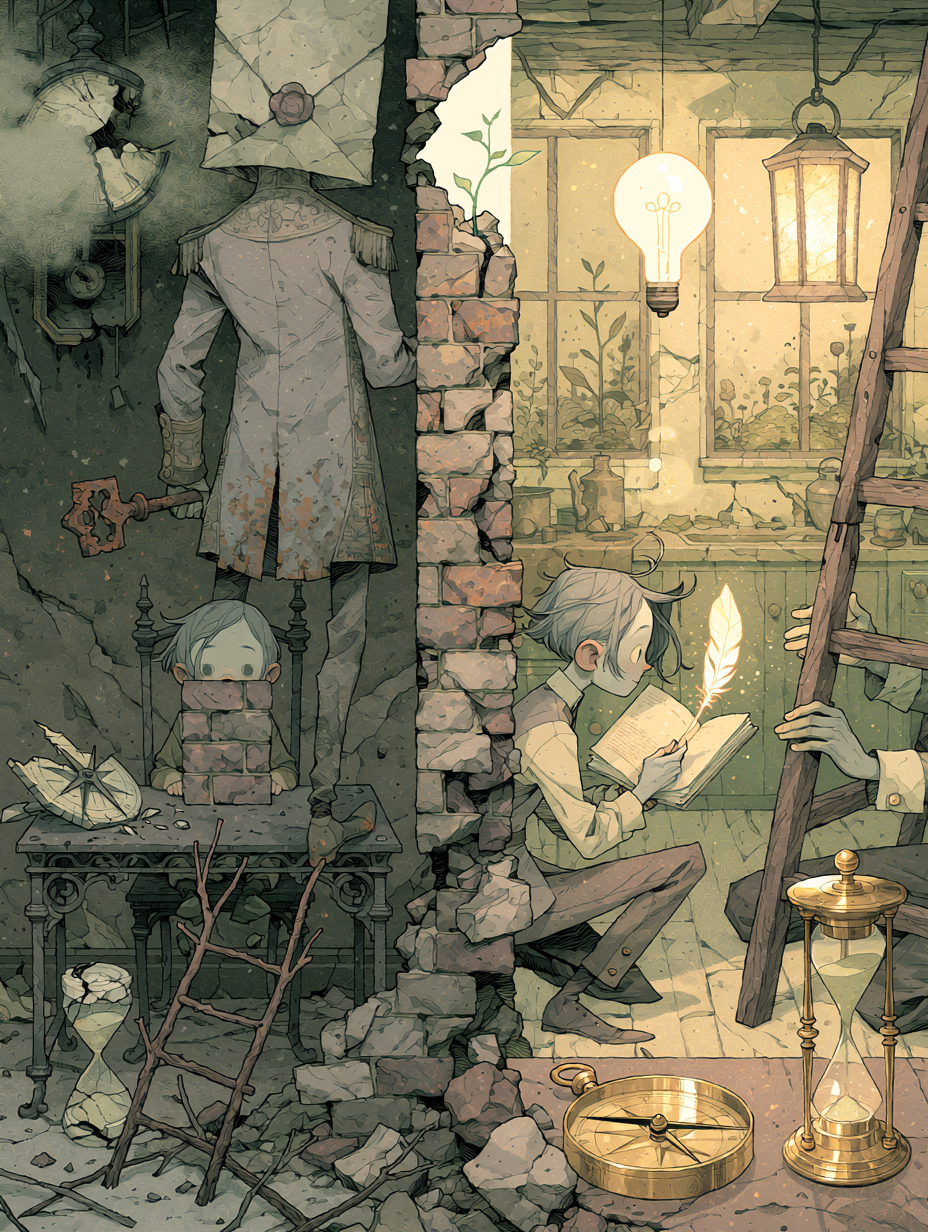
There is one more room to enter before the book turns to face you directly.
It is the one almost no one wants to look at, because it is the room you were made in.
Every mechanism this book has named,
the wall,
the flood,
the seal,
the ladder,
the road of genuine love that carries the untestable claim,
you met all of them, for the first time, long before you had any words for them, in your family.
The family is where the brake is first built, or first broken.
It is where you first learned whether a question is welcomed or punished.
Whether love is something freely given or something metered out as a reward for not asking.
It is the first ladder you ever stood on, with someone above you and, often, someone below.
It is where you first learned, by direct experience, what gets done to the rung beneath when the rung above is frightened or angry or simply tired.
The child who learns that the people they love most cannot be questioned. The child taught to doubt the story is to betray the family.
That child has been taught the seal in the most intimate form it will ever take.
Taught it so early and so deep that it will feel, ever after, not like a lesson but like the shape of reality itself.
That child grows up and recognizes the same move everywhere, in the boss whose judgment may not be questioned, in the leader whose authority is ordained, in the cause whose certainty may not be doubted.
This child grows and recognizes it not as a danger but as home, and walks toward it.
It is also in the first room where the signals from the map are first calibrated.
The child who is allowed to feel shame, have it be heard, correct the thing that caused it, and release it, grows up with a functioning moral compass.
The child for whom shame is weaponized, deployed as a permanent condition rather than a temporary signal, learns that the feeling means they are bad rather than they did something bad, and carries that confusion into every relationship and every institution for the rest of their life.
The child who is allowed to be afraid, to name the fear, to be helped through it, and to release it, grows up able to use fear as information.
The child for whom fear is manufactured as a management tool grows up chronically alarmed, the brake worn down before it was ever fully built.
And the rescuer research points straight back here too, which is the hinge of the whole thing.
The single strongest thread the studies found among the people who sheltered strangers at mortal risk was not ideology or faith.
It was a particular kind of family:
homes where the parents had explained their reasoning instead of merely commanding, where discipline was not arbitrary cruelty, where the child had been treated, early, as a person whose inner life was as real as the adults’.
The habit that held under the worst pressure the century could produce was built at a kitchen table.
Decades before it was needed.
By parents who almost certainly had no idea they were building anything at all.
This is the most important and most hopeful fact in the book, and I have saved it for here on purpose.
The conditions that make a rescuer are rare and fragile, yes.
But we know, with as much certainty as this kind of thing allows, where they are built.
They are built in the first room,
in the daily,
unglamorous motion of a parent who explains rather than commands,
who lets the question be asked,
who treats the small person on the rung below as someone whose reality is real.
That cuts both ways, and the book will not flinch from the second edge.
If the first room is where rescuers are made, it is also where the machine reproduces itself most efficiently, one child at a time,
for free,
with no enforcer required,
passing the wall and the seal and the unquestioned ladder down through the people who love each other most and least suspect what they are handing on.
The most political act in this entire book may turn out to be the least political-looking one:
the choice, made daily and exhaustingly and without applause, to run the first room as a place where questions are safe, where signals are allowed to complete their cycle, where the person below you is real.
That is not a metaphor for resistance.
By the evidence, it may be the literal place most of it is actually made.
> To the top of the ladder: what are you installing in the first room you preside over, by command or by example, and would it produce someone who could question you, or only someone who could obey the next person who stands where you stand now?
> To everyone else: what did your first room teach you about whether questions are safe and whether the person below you is real, and which of those early lessons are you still obeying without ever having chosen to?