From The Witness
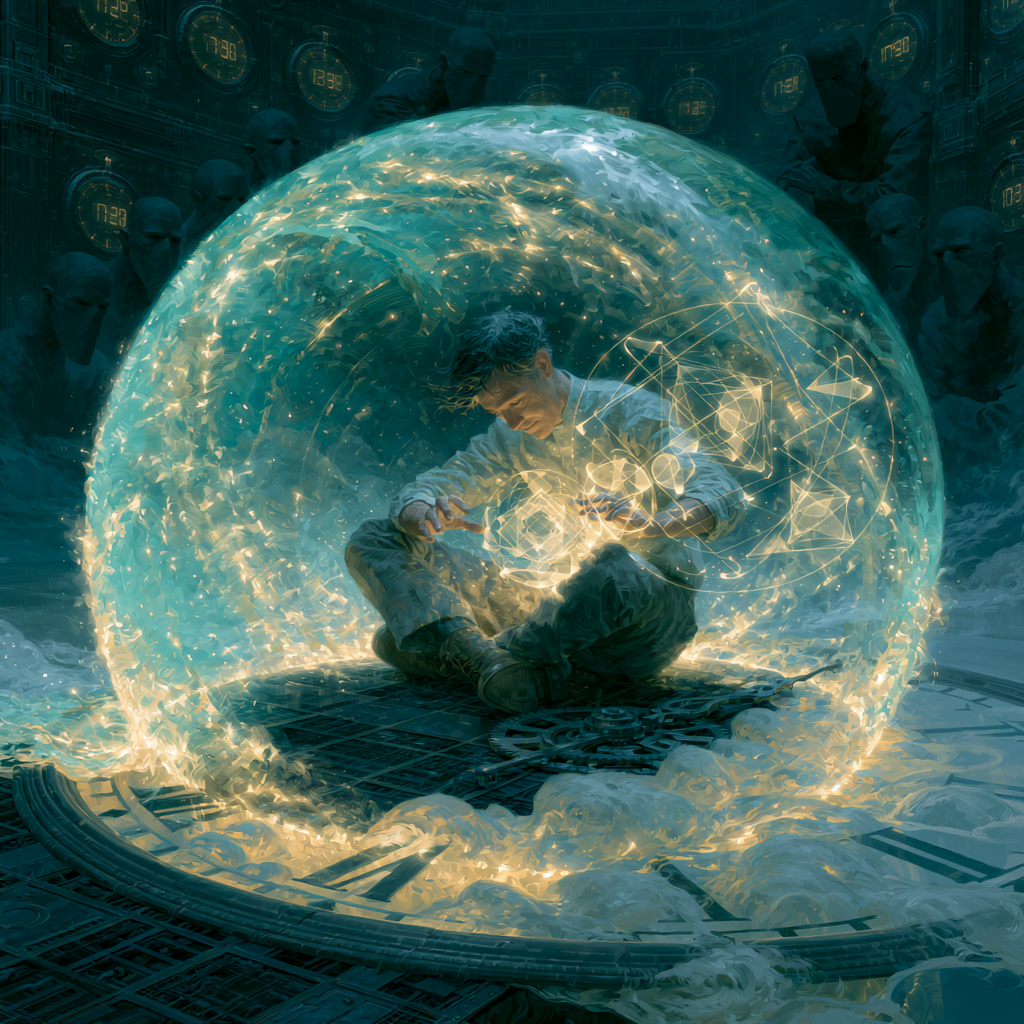
Before I name the mechanism, I want to name the experience.
If the mechanism lands first the experience gets filed as an illustration and it is not an illustration.
It is the thing itself.
You know what it felt like.
You were inside something, a game, a piece of music, a story, a conversation that had caught fire, and the normal categories dissolved.
The clock stopped mattering.
The part of your mind that monitors how you appear to others went quiet. You were entirely immersed, feeling truly awake for the first time all week. Then, an interruption snapped you out of it. Coming back to reality felt sudden and slightly painful, like breaking the surface of the water after a deep dive.
That state is not leisure.
It is not rest.
It is a specific and documentable mode of brain operation that researchers call flow.
Unlike any other brain state, this one allows your analytical “prefrontal brake” to run at full capacity while your internal alarm system stays completely silent.
It is the brake finally getting to do its job without the noise.
The brain is making decisions,
weighing options,
inventing rules and breaking them,
running experiments in real time,
and none of it feels like work because the stakes are suspended and the intrinsic reward is the activity itself.
Not anything the activity produces.
This is why play is the oldest friction.
Not because it teaches lessons or builds character in the way a motivational poster would claim.
Because it is, structurally, the exact opposite of what the machine needs you to be doing.
The machine needs the brake worn down and the alarm running hot.
Play rests the brake and silences the alarm.
The machine needs you organized around extrinsic reward, the wage, the grade, the metric, the consequence.
Play runs on intrinsic motivation, doing the thing for the doing of it, and there is documented psychology behind this:
when an external reward is made salient enough it crowds out the intrinsic motivation and the activity stops being play.
The machine’s primary motivational technology and genuine play are structurally incompatible.
You cannot pay someone to play in the way that play actually works.
The machine does not ban play.
You cannot ban a bodily state.
What it does is enclose the conditions play requires.
Play needs safety.
Not comfort but the specific safety of knowing that failure inside the game has no real consequence.
That the experiment is permitted to fail.
A child under genuine threat cannot play.
A person whose basic needs are precarious cannot play.
The nervous system under real alarm is running threat assessment.
The brain cannot afford the metabolic cost of running simulations feeling all stakes are removed.
Because the stakes are not removed, they are everywhere.
So the machine maintains exactly the level of precarity and chronic alarm that makes real play unavailable to the people it most extracts from.
It then sells them the branded substitute.
The scheduled, metricked, purchasable version of the experience, in the time slots it has not already claimed.
And the peer enforcement system from the watchers watching each other post handles the rest.
Adult play in most institutional contexts collapses not because adults cannot play but because the shame cost of being seen playing is too high. Irresponsible. Unserious. Not a team player.
The machine does not have to forbid adult play.
It only has to maintain a social environment in which play reads as a deviation.
The peers will enforce the norm for free, the way they always do.
But here is what the machine cannot enclose.
The impulse itself.
The wanting to play is in the body the same way the wanting for salt is in the body,
older than any institution,
wired below the level where the machine can reach.
And when it fires, when real play happens, it does something the machine finds genuinely dangerous.
It produces, for free, without permission, the thing the unimaginable post identified as the hardest to build:
the visceral experience of an alternative.
A person in genuine play is not inside the machine’s categories for that time.
They are somewhere else entirely.
And somewhere else entirely is the thing the seal most needs to never exist.
> To the top of the ladder: are your people producing out of inspiration, or is their anxiety the actual engine of your growth?
> To everyone else: when did you last play in the way that made the clock stop, and whose enclosure of the conditions for it are you accepting as the natural cost of being an adult?