From The Witness
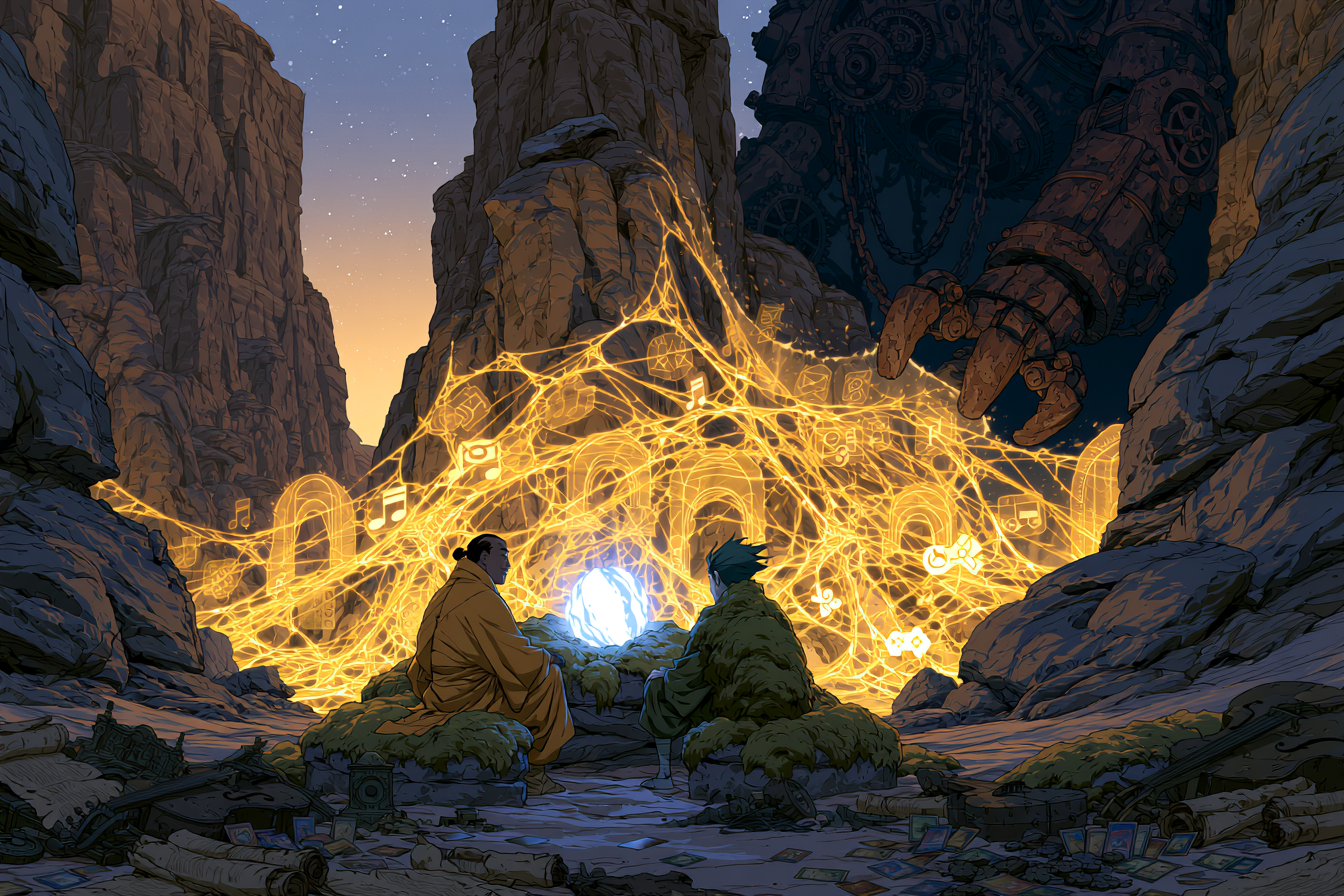
When two people discover they grew up with the same game,
the same show,
the same music,
something happens that is not just rapport.
They have established that they inhabited the same imagined world,
ran the same simulations,
felt the same stakes that had no real stakes.
They share a reference set that was built entirely inside the play space.
It belongs to neither of them and both of them simultaneously.
It is a genuine commons.
Nobody owns it.
Nobody can charge for the recognition that lights up between them.
The handshake is free.
This produces something the machine finds difficult.
It produces trust that did not go through the machine’s channels.
The normal mechanisms of trust in the machine’s world run through credentials, institutions, money.
The rooms that you have been selected to enter.
But the person who says we both played that game,
we both stayed up too late watching that show,
we both know what it felt like when the music hit that moment.
They have established a connection that bypasses all of those.
The shared play world is a commons of experience, and the commons produces solidarity the machine did not authorize and cannot easily price.
Now the harder thing, because the book would be dishonest if it only told the warm half.
The same mechanism that builds free solidarity inside the group builds walls around it.
The people who shared the world know things the people who did not share it do not know.
The references, the jokes, the shorthand, the feeling of recognition.
This is not neutral.
It is structurally identical to the tribal mechanism from the tribe post.
The shared imagined world becomes an identity, and the identity has an inside group and an outside group.
The outside is the people who did not inhabit that world, who do not get the reference, who are not in on it.
Here is the precise thing the machine learned to do with this.
It did not have to manufacture the in-group feeling.
The in-group feeling is what shared play produces naturally,
for free,
as a byproduct of the experience.
What the machine did was enclose it.
Brand it.
Make the game, the show, the music into a product.
Attach identity to the product.
Then let the natural in-group formation mechanism do the rest.
The person who buys the shirt is not only buying a shirt.
They are buying membership in the solidarity.
The shared experience the shirt produced.
The machine is collecting the toll on a commons it did not build and does not own.
This is the most sophisticated version of the enclosure move in the entire book, because it does not destroy the commons.
It attaches a gate to the identity the commons produces.
The commons keeps generating the solidarity that makes the gate worth paying to pass through.
But here is what the enclosure cannot reach.
Two people who played the same cheap game,
watched the same pirated show,
grew up with the same music nobody was selling anymore,
have the same commons as the people who paid for the premium version.
The experience is the thing.
The experience is the commons.
The badge is the enclosure of the experience.
The experience itself preceded the badge and survives the badge and can be had without the badge.
This is why the machine keeps extending copyright terms,
keeps rebooting and rebranding,
keeps trying to put a new gate in front of an old experience.
Because the old experience keeps escaping into the commons and producing solidarity it cannot charge for.
Games do something that shows and music do not quite do in the same way.
Games require you to make decisions inside the world.
You are not only a witness to the story.
You have agency, limited and structured agency, but genuine agency within the rules of the world.
This means the person who played a game with you has not only shared an experience.
They have shared a decision-making environment.
They know something about how you think under pressure,
what you prioritize,
how you handle loss,
whether you play to win or play to play.
No credential certifies that knowledge.
No institution grants it.
It exists only between the people who were in the game together.
A commons of mutual understanding that nobody built for profit and nobody can quite take away.
The card game in the kitchen.
The street game with no trademark.
The music session nobody recorded.
The thread on a forum where people argued about something nobody was paying them to care about.
These produce the deepest version of the commons solidarity and leave the least trace for the machine to enclose.
They happen and they are gone.
What remains is only in the people who were there, and a shared world that has little to no artifact.
Mostly memory and the recognition that lights up when two people who were both there meet again.
> To the top of the ladder: which shared worlds are you selling people admission to that they used to be able to build for free, and how much of your margin depends on the difference between the experience and the badge being invisible to the people paying for the badge?
> To everyone else: what shared world do you carry with someone that nobody sold you, and what did you know about them afterward that no institution could have told you, and when did you last build one of those on purpose?