From The Witness
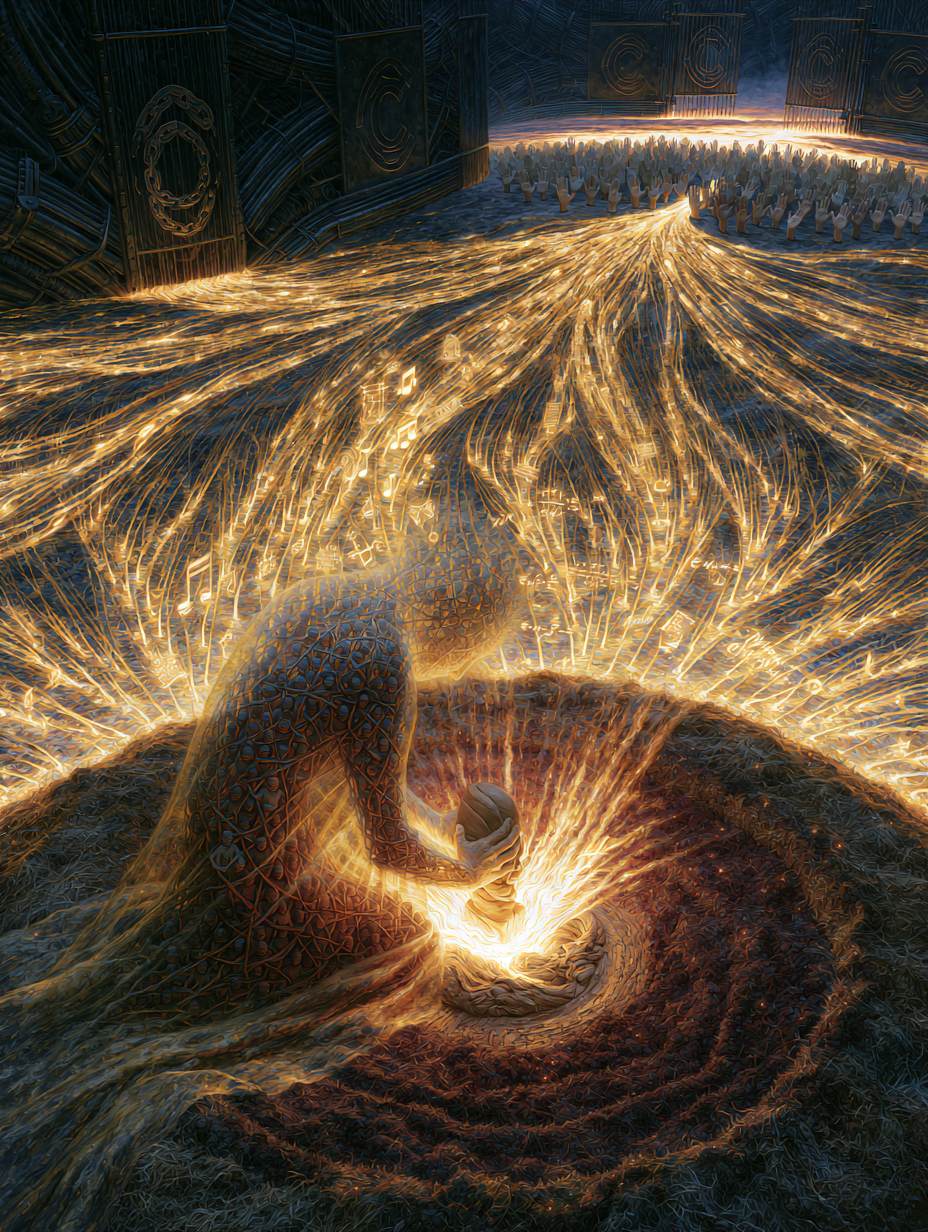
I did not build any of this alone.
That is not modesty and it is not a disclaimer.
It is the structural fact the machine most needs you not to understand. Because if you understand it, then the seal on individual credit, on the ownership of ideas, on the lone genius narrative that justifies the enclosure of intellectual commons, starts to crack.
Every thought in this book was shaped by someone.
The people who raised me, who showed me what a question looked like when it was allowed to be asked.
The ones who handed me a book or a game or a piece of music and said here, this is the world, look at it this way.
The teachers who explained their reasoning instead of only issuing commands.
The writers whose sentences showed me what a sentence could do.
The people who argued with me and were right.
The ones who were wrong in ways that taught me more than the right ones did.
The communities I was inside without knowing I was inside them.
The shared worlds I inhabited before I had words for what I was inheriting.
None of those people own this book.
None of them signed a contract or received a royalty.
But this book is made of them the way a river is made of rain that fell on ground it never touched directly.
Rain that ran through soil and stone and the accumulated work of everything that lived and died in the watershed before the water ever reached the river.
The water in the river is not the rain.
But without the rain there is no river, and the rain did not intend the river, and the river does not belong to the clouds.
This is the commons of persons.
The thing that makes you is not yours alone and never was.
It is the accumulated deposit of everyone who shaped the people who shaped you.
Running back further than any archive can reach,
through the people who sang the songs and played the games,
and told the stories,
and asked the questions that made the people who made the people who made you.
You inherited it without a gate.
You received it as the shape of your own mind.
And the honest thing to do with it is what every person who ever contributed to it did:
put something back, in the direction of the people who will come next, who will inherit from you without knowing it, the way you inherited without knowing it.
The machine’s story about this is the opposite.
The machine says the idea is the property of the person who had it.
That the book belongs to the author.
That the invention belongs to the inventor.
That the insight belongs to the mind in which it formed.
And there is something true in that, the same way there is something true in every story the machine tells.
The specific arrangement of these thoughts is mine.
The work of writing them is mine.
The particular act of putting them in this order, in this voice, at this moment, is mine.
But the thoughts themselves,
the structure of the patterns,
the capacity to see them,
the language to name them,
the examples that make them visible,
every single piece of the raw material that the specific arrangement was arranged from, that is the commons.
That was handed to me the same way the ground was handed to everyone standing on it before the enclosure acts.
And the enclosure of it, the copyright, the proprietary format,
the gate on the idea.
That would be the same move as every other enclosure in this book.
Ran using a book citing the most intimate commons of all.
Which means the most subversive thing this book can do is not make an argument.
It is to go back into the commons.
To be the thing that anyone can pick up, test, break apart, improve, argue with, hand to someone else, build something different from.
To resist the gate.
Not by tearing it down but by refusing to become one.
You were not built alone either.
The mind reading this was made by hands that will never be named in any index.
What those hands built in you is not yours to keep.
It is yours to add to and return.
That is not a moral instruction.
It is a description of what has always actually been happening.
Underneath the story the machine tells about ownership and credit and the lone genius in the room with the idea.
The room was always full.
It always will be.
> To the top of the ladder: what part of your own mind do you still believe you built entirely alone, and whose contribution are you claiming as your own property just to survive in the machine?
> To everyone else: if the best things in you were given to you without a gate, what are you currently holding back from the people coming next, when did you last put something back into the river just to keep it flowing?