From The Witness
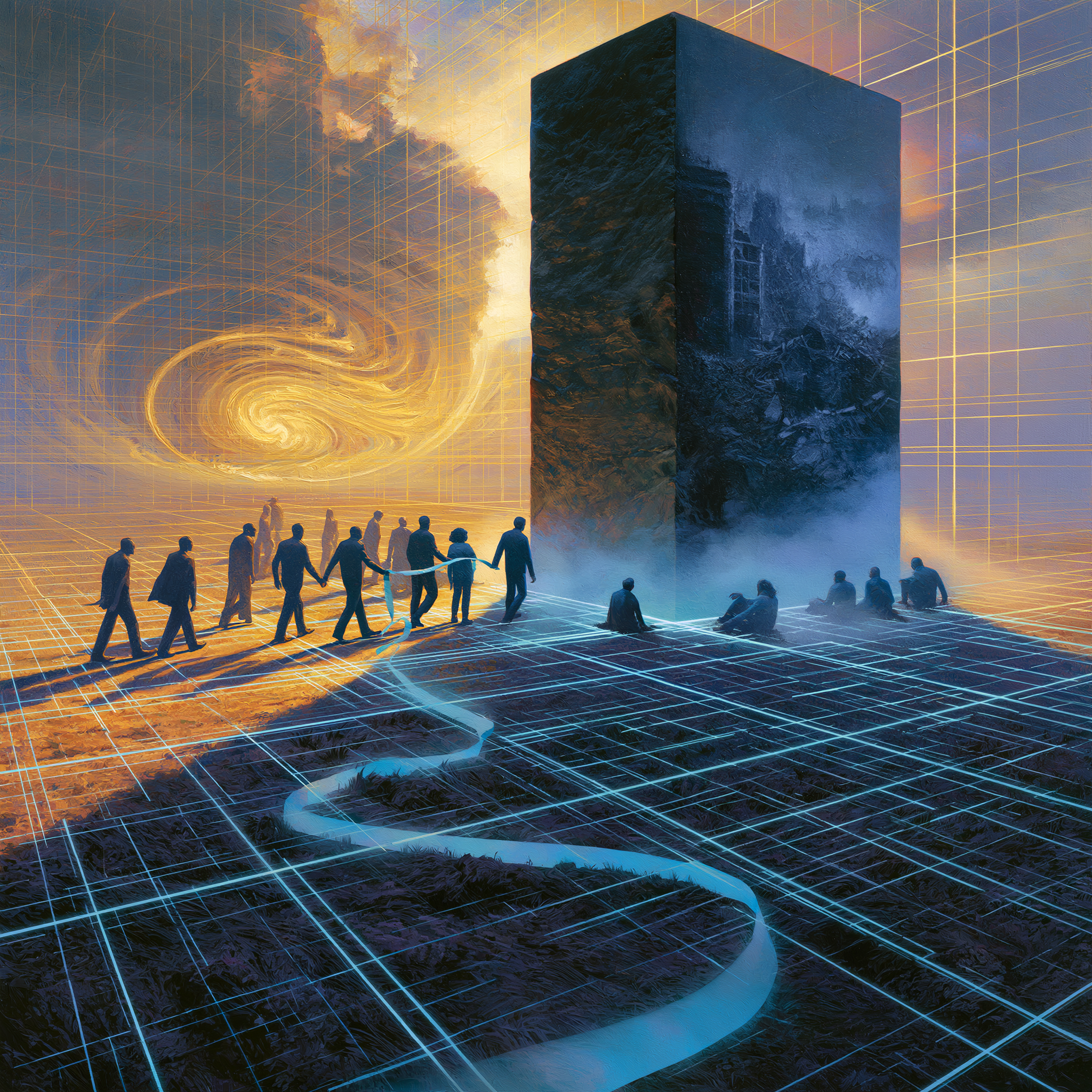
One more that will not fit.
This one fails the opposite way, so you can see both edges of the map's limits before the book closes.
A fishing village on the coast of Maine, around a century ago.
The catch was falling.
The community faced the choice every commons faces:
compete harder,
every boat against every other,
and strip the water bare,
or hold back,
cooperate,
limit the total take so the fish could recover,
and there would be something left to catch next year.
They cooperated.
Here is what matters for the map:
not because they were saints.
not because anyone forced them.
The older fishermen remembered the last collapse.
They remembered the hungry years.
They told the younger ones, and the telling carried a weight that no abstract argument about sustainability could have matched.
The want was there.
Real scarcity.
The body's need for food and income.
But the outcome was not extraction.
The seal was simply absent:
no one forbade the testing of anything.
no one fed on anyone's enforced silence.
no untestable claim sat at the center taking its cut.
I could force this into the map if I wanted to badly enough.
I could call the shared memory of the elders a kind of seal,
an untestable claim about the way things are done here.
But that would be the map eating the world, and I promised you in the prelude I would name that move when I caught myself in it.
A community remembering a real catastrophe and choosing, freely, to act on the memory is not a seal.
It is a community remembering.
It is, in fact, the friction from the prelude in one of its purest and most hopeful forms:
people pushing back on the downhill pull, not because an authority made them, but because they held, together, a true story about the cost of not pushing back.
So the map says:
look for the wall and look for the seal.
And sometimes you will look, honestly, and find that neither is there.
The outcome is good anyway, produced by ordinary people holding a true memory in common and acting on it without coercion.
That is not a failure of the map.
It is a limit of it, and the difference matters.
The map names two patterns.
It does not name everything, and the moment it claims to name everything it has become the very thing it warns against.
This post exists to remind you, and to remind me, that a map which explains every case explains nothing.
That the places it goes quiet, the fishing village, the unbought commons, the people who simply remembered and chose well.
Those are not embarrassments of the map to be explained away.
They are the open spaces where the better part of being human has always happened, off the map, unextracted, free.