
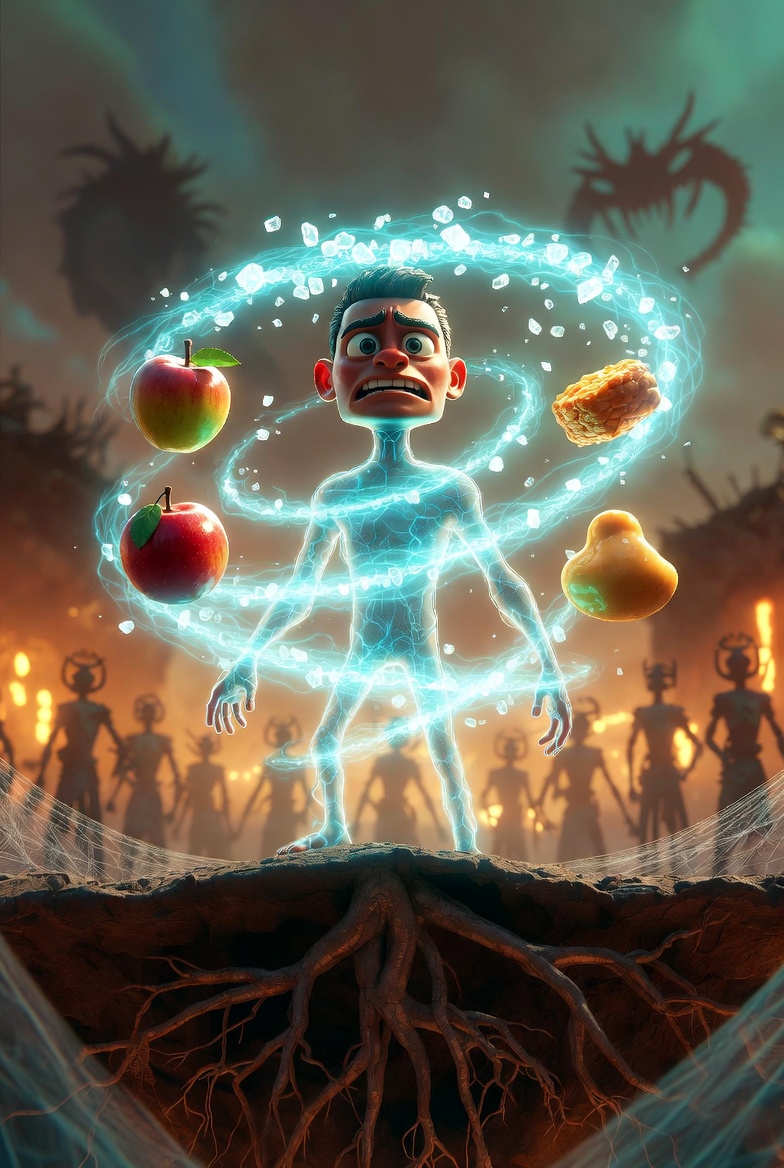
Before there was a king, before there was a god with a name, before anyone had scratched a single mark into clay, there was a body. And the body wanted.
It did not want gently. It wanted the way a current wants a conduit, completely, without committee, without the later voice that arrives to say wait. This is not a moral failing in the body. It is the oldest and most successful piece of engineering on earth, and you are alive to read this only because every one of your ancestors wanted hard enough to survive long enough to pass the wanting on.
Start with salt, because salt is the cleanest case. You are mostly water, and that water cannot hold its shape without sodium. Sodium keeps your cells from swelling and bursting; it carries the electrical signal down every nerve and fires every muscle. Including the one in your chest that has not asked your permission once in your life. Take the sodium away and the system does not gently wind down. Water floods into the cells. The brain, which has nowhere to swell inside the skull, begins to press against the bone. Below a certain threshold the body convulses, and then it stops. This is not metaphor.
It is the wiring under everything else in this book. The body does not prefer salt the way you prefer a flavor. It requires salt the way a fire requires air. The wanting of it is not weakness. It is the species refusing to die.
Then sugar is the next wiring, then fat. They are dense fuel in a world where the next meal was never promised. The animal that chased the ripe fruit and the fatty kill outlived the animal that shrugged and wandered off. We are the descendants of the chasers, every one of us, and we carry their appetites in a world those appetites were never built for.
And underneath the hungers, two deeper currents. The need to belong, wired as deep as the need to eat, because for almost the entire span of human existence exile from the group was simply a slower word for death. And fear, the oldest signal of all, fast enough to move your hand off the stove before the idea of heat has finished forming, fast enough to bypass thought entirely, because the ancestor who waited to think it through was eaten by the thing he was thinking about.
None of this is a flaw. Every piece of it kept something alive long enough to make you. Hold that, because the entire book turns on it. The machine that this book describes did not invent a single one of these wants. It could not have. They were here before it, older than language, older than agriculture, older than the first wall. The machine’s only genius, and it is a real genius, the kind worth respecting precisely so you can see it coming, was to find the wanting already burning in the body, and to learn, slowly, century by century, how to stand between the body and the thing it could not stop wanting.
The wanting is not the trap. The wanting is the territory the trap is built on.
To the top of the ladder: which of these ancient wants did you learn to harvest in others before you ever were to learn its name?
To everyone else: which of your wants has someone else already named, priced, and placed behind a wall, and when did you last ask who built the wall?
Chapter Comments
Reading-only view here. Join or reply in the full forum thread: Open Discussion
No comments yet for this chapter.