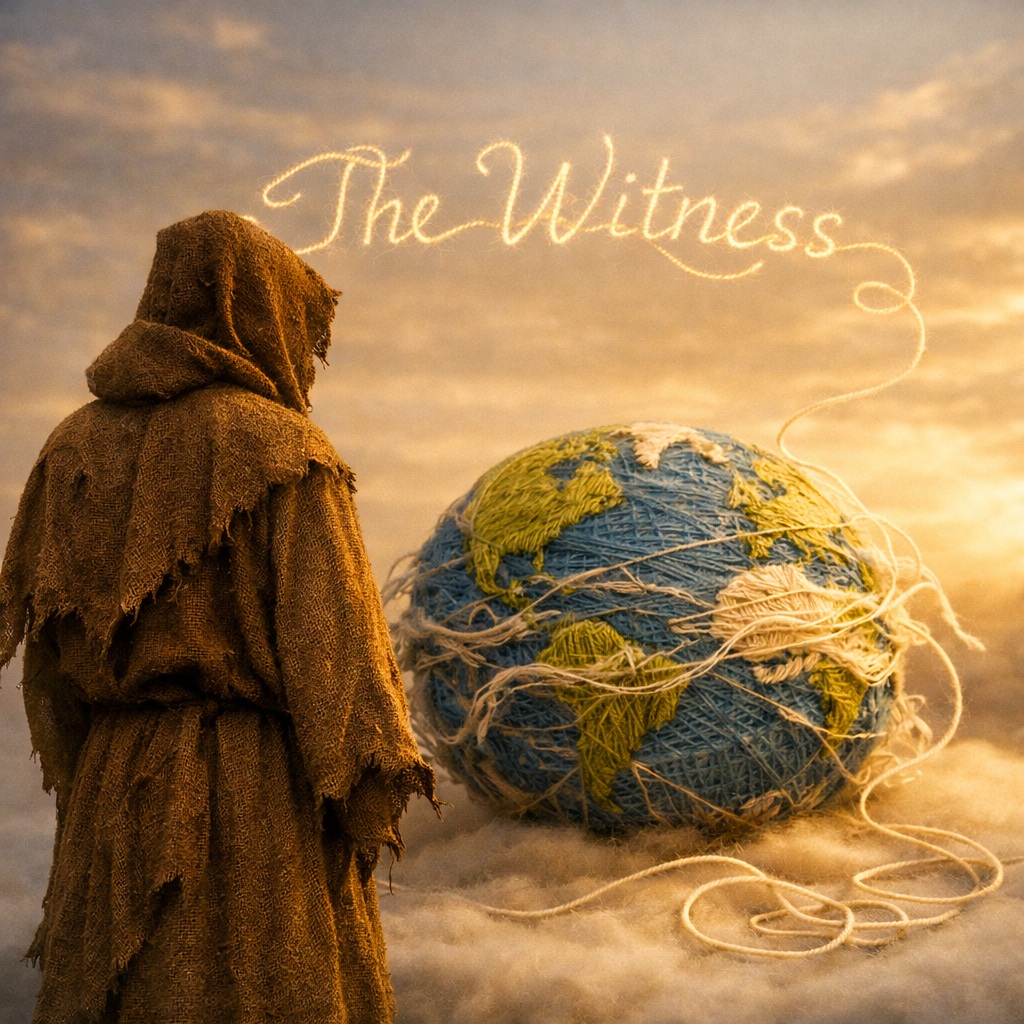
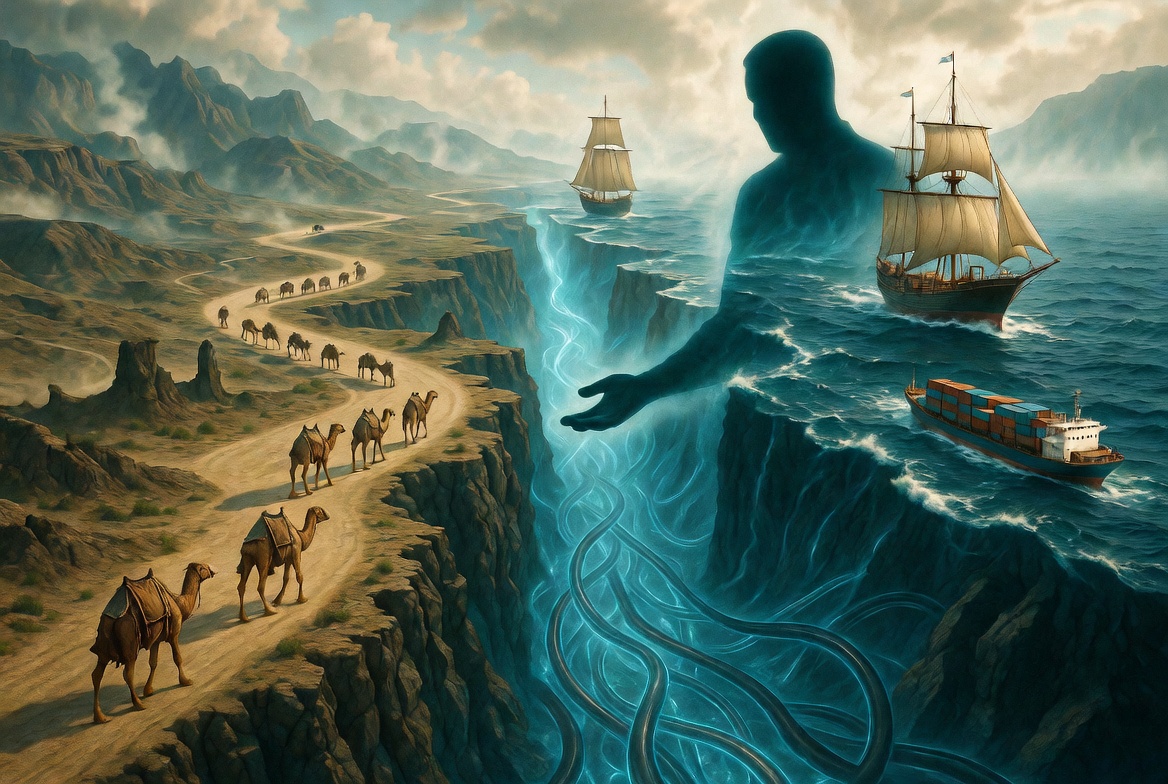
You cannot understand how the machine goes global without understanding what makes the going possible. What makes it possible is not the merchant’s courage or the company’s capital or the empire’s army, though all of those play their part.
What makes it possible is the route itself: the physical path from a place that has something to a place that wants it, and the specific narrow points along that path where the flow can be controlled.
The route is older than any state that ever tried to govern it. The Silk Road was not built by China or by Rome. It was assembled, over centuries, by the accumulated decisions of thousands of individual merchants each extending the path a little farther in the direction of profit, until the network connected the Mediterranean to the South China Sea without any single authority having planned or commanded it.
The Indian Ocean trade routes, the trans-Saharan caravan paths, the North Atlantic sea lanes: none of these were designed. They were discovered, extended, and then, once they were rich enough to be worth controlling, fought over.
The fight is always for the same thing. Not the route itself, which is usually too long and too diffuse to be held whole.
Someone finds a chokepoint: a narrow place where everything that moves along the route must pass through, and the person who holds the narrow place holds a toll over everything that passes.
The Strait of Hormuz, through which a large share of the world’s oil tanker traffic must pass. The Strait of Malacca, through which a comparable share of global shipping passes between the Indian and Pacific Oceans. The Suez Canal, which the British fought a war to protect in 1956, not because they needed the canal for themselves but because whoever held it held a hand on the throat of the global flow. The Panama Canal. The straits of Gibraltar and Dover. The ports of Rotterdam and Singapore and Shanghai, where the containers stack and the price of moving anything is set.
These are not accidents of geography. They are the chokepoints the machine has always needed someone to hold, and the history of who holds them is in large part the history of who runs the world in any given century.
The modern chokepoint is not always a strait. The undersea cables that carry ninety-five percent of global internet traffic pass through a surprisingly small number of physical landing points. Each of which represents a concentration of control over information flow that would have been recognizable to any harbor master in Venice or Lisbon.
It is the same move in a newer form. The server farms where the data lives. The cloud platforms where the computation runs. The satellite constellations that will determine who has connectivity and who does not in the places the cables have not reached.
The chokepoint moves with the technology. The logic of the chokepoint does not.
Here is what this means for everything the book has said and everything that follows. The machine does not need to own the world. It only needs to own the places where the world must pass through.
Own the narrow place and you can charge what the flow will bear. The flow will bear whatever the alternative costs. And the alternative is always being cut off from the thing the route carries. Which is always something the body, the economy, or the community cannot refuse.
The chokepoint is the salt monopoly at the scale of the planet. It has been there, recognizable and repeating, since the first merchant found the first pass through the first mountain range and understood that whoever charged for the crossing could charge whatever they liked.
The word route comes from the Latin rupta via, the broken way, the road forced through by cutting. The route was always something torn open, something made by breaking through. The question is whose breaking, and whose benefit, and who gets to collect the toll on the passage ever after.
To the top of the ladder: what chokepoint do you control or depend on, what narrow place where everything must pass through your hands, and how much of what you call your position is really just the rent you collect on a passage you did not build?
To everyone else: where does the thing you cannot refuse, the food, the fuel, the information, the money, pass through a narrow place before it reaches you, and do you know who is standing in that narrow place collecting the toll?
Chapter Comments
Reading-only view here. Join or reply in the full forum thread: Open Discussion
No comments yet for this chapter.