If you wanted to own people and you were patient, you would not start with chains. Chains are expensive, they are visible, and they make the owned person into an enemy who is awake to what you are.
You would start with something the body cannot refuse, and you would put yourself between the body and that thing. Then you would not need chains. The need would do the work the chains used to do, and the owned person would carry it willingly, and call you the one who provides.
Salt is the oldest version of that move on record.
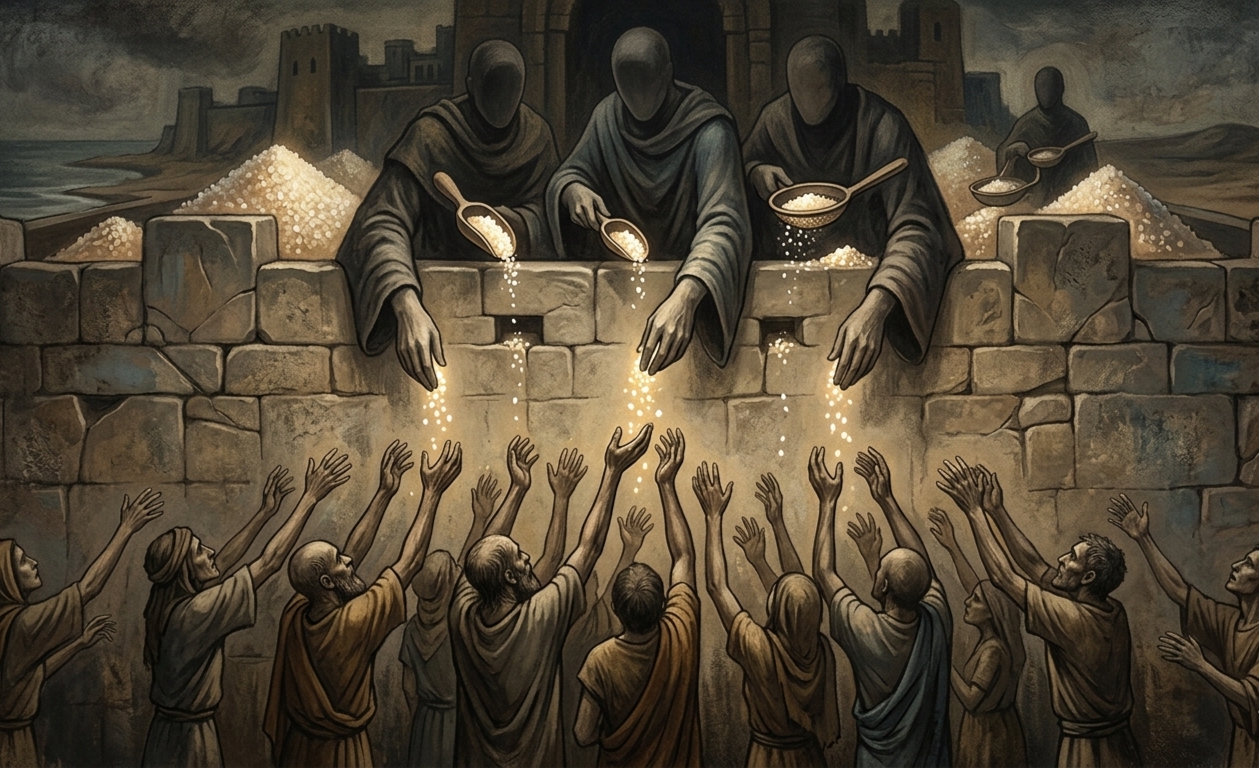
You cannot choose not to need salt. We established the wiring already: take it away and the body convulses and stops. And for most of human history salt was not lying around. It had to be mined from the earth or boiled out of the sea or scraped from the dried beds of ancient lakes, which meant it could be found, and held, and metered out by whoever got there first. A thing every body must have, that only some hands control, is not a commodity. It is a leash that the leashed mistake for a lifeline.
Every durable power figured this out, independently, on every continent, which is exactly why it belongs in this book, not as one civilization’s crime but as a move the structure offers up to anyone standing in the right place. Imperial China ran a salt monopoly so old and so central that the revenue from it helped underwrite the state for the better part of two thousand years; at points it funded a large share of everything the government did. Rome paid and provisioned along the salt roads, and left the word salary behind as a fossil of the arrangement, the wage and the salt remembered in the same breath. India’s colonial rulers turned the salt of a coastline into a tax on the people who lived beside it, until walking down to the sea and lifting a handful of it became an act of rebellion serious enough to shake an empire.
Look at the shape under all of it. The want is real and it is in the body, not the mind, so it cannot be reasoned away or waited out. The supply is gatherable into a few hands. And the price is whatever those hands decide, because the alternative to paying is not inconvenience. The alternative is death, and everyone on both sides of the wall knows it.
This is the wall in its first and purest form, before it learned to hide. There is no story dressing it up yet, no claim you are forbidden to test. That comes later, and when it comes it will make walls exactly like this one feel as natural and permanent as weather. But here, at the beginning, you can see the bones with the skin still off: find the thing the body cannot refuse, get between the body and the thing, and name your price.
To the top of the ladder: What is the modern salt you are metering out, and how do you keep the hungry from realizing that your gate is the only reason they are starving?
To everyone else: Whose ledger are you writing your life into just to buy back the right to exist tomorrow?
Chapter Comments
Reading-only view here. Join or reply in the full forum thread: Open Discussion
No comments yet for this chapter.