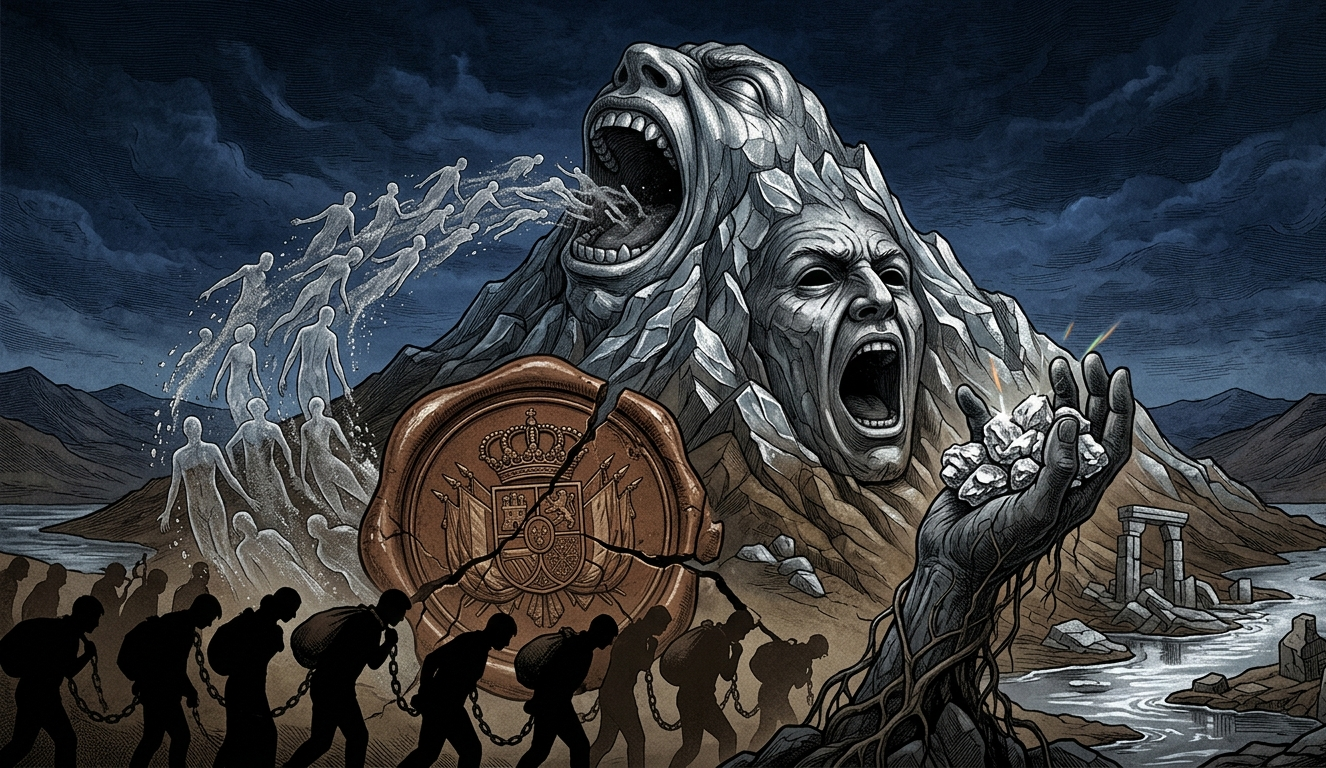
High in the Andes, in what is now Bolivia, there is a mountain that the people who were sent to die in it called, with terrible accuracy, the mountain that eats men. The Spanish called it Cerro Rico, the rich hill, and for a time it was the single most valuable piece of ground on the planet.
The numbers are worth holding even where they are disputed, because the dispute is itself part of the lesson. Across the colonial centuries, somewhere on the order of sixty thousand tons of silver came out of that mountain. For much of the seventeenth century, Potosí alone produced something close to sixty percent of all the silver mined anywhere on earth.
The Spanish crown took its share, and that silver underwrote European banking from Antwerp to Genoa, paid for wars across three continents.
The Silver flowed east in such quantities that it became, in the form of the Spanish piece of eight, something the world had never had before: a genuinely global currency, circulating from Madrid to the markets of Ming China. A coin stamped with a P, mined by people who would never see any of the worlds it bought.
The labor came from the mita. It was a rotating system of forced work. Formalized by a Spanish viceroy in the 1570s, that required sixteen Andean provinces, some of them many hundreds of miles away. To send a steady quota of men, on the order of thirteen thousand at any given time, to work the mountain in months-long shifts. They were paid a wage that generally did not cover the cost of staying alive.
They hauled sacks of ore up shafts hundreds of feet deep, again and again. Through dust and dark and the fumes of the mercury used to refine the silver. The journey to the mountain and back broke families and emptied the home villages of their men.
How many died is genuinely unknown and genuinely argued over: the largest figure cited, around eight million, counts the dead of the entire colonial viceroyalty across more than two centuries, not the mines alone. Careful historians focused on the mines themselves put the toll somewhere from the hundreds of thousands into the low millions. A range that reflects both the difficulty of the historical record and real disagreement among scholars working from that record.
I am not going to pretend to a precision the record does not support, and I am not going to reach for the highest available figure to make the moral point seem larger than the documented one. The honest version of the documented one is devastating enough.
A mountain ran for two and a half centuries on a rotation of human beings fed into it and used up, and the wealth it produced built a world those human beings were never permitted to enter.
Here is the part that connects it to everything else in this book. The miner hauling ore in the dark had no idea that the coin his labor became. At that very moment, his labor was balancing the tax accounts of an empire on the far side of the planet. An empire he had never heard of and would never see.
And the official in Ming China who accepted that silver, who watched it become the basis of how his entire economy reckoned value. The official had no idea and no reason to think about a dying man in a mountain in the Andes. The extraction sat at one end. The abstraction sat at the other. And between them stretched a distance so vast that neither end could see the other, which is precisely what made the whole thing run.
You can work a man to death far more easily when the people who benefit will never have to watch, and when the man himself cannot see who benefits.
The distance is not a side effect of the machine. The distance is the machine's most useful product. It is the thing that lets extraction at one end and comfort at the other coexist without either end ever having to feel the other.
To the top of the ladder: how long is the distance, in your arrangement, between the people who are used up and the people who enjoy what their using-up produces, and how much of your peace depends on that distance staying long enough that you never have to look down the shaft?
To everyone else: what are you holding in your hands right now, a metal frame, a glass screen, or woven cloth, and what is its true cost that was paid by someone on the other side of a distance designed to keep us blind?
Chapter Comments
Reading-only view here. Join or reply in the full forum thread: Open Discussion
No comments yet for this chapter.