
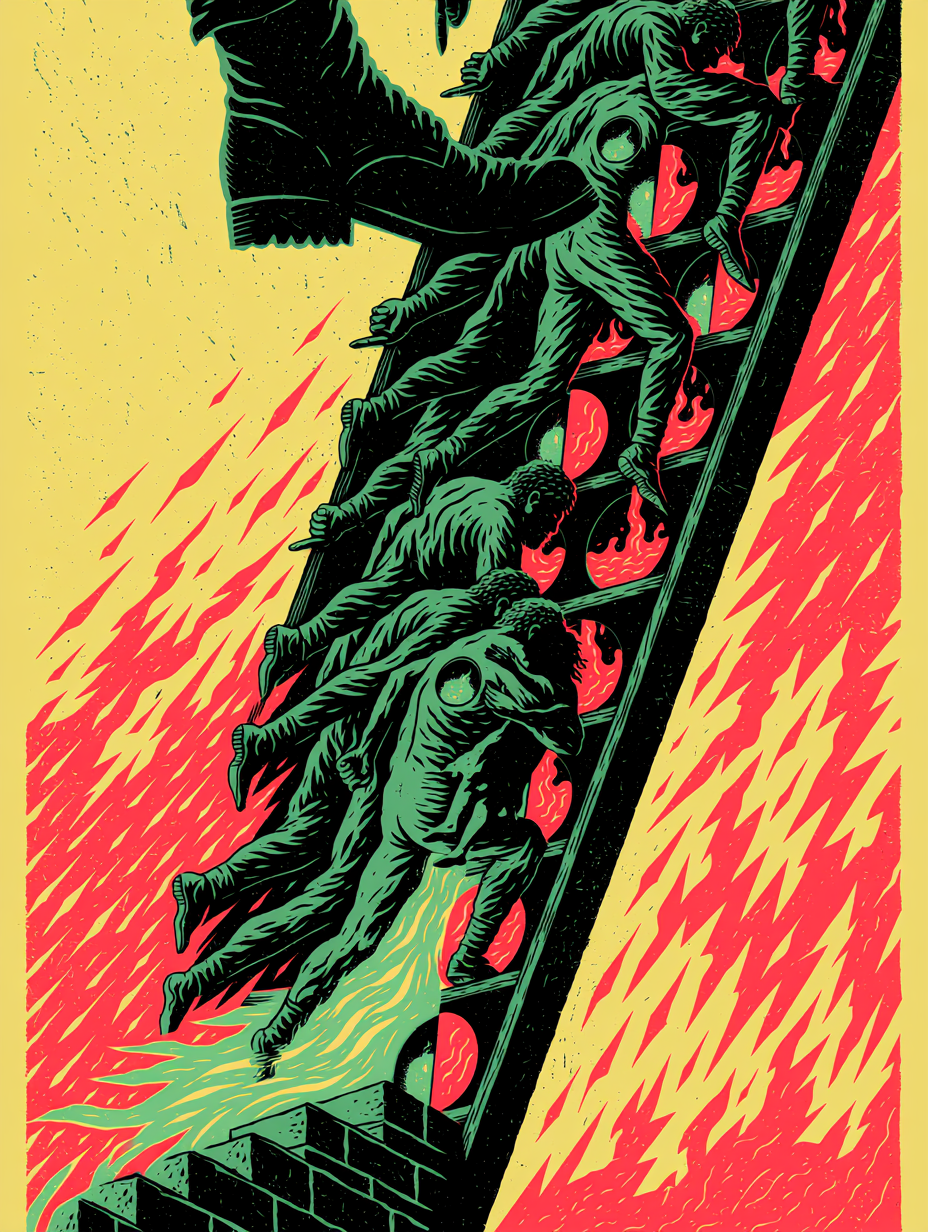
In a witch trial, hiding the accused got you hanged beside her. Informing on a neighbor earned you standing in the community. Doing the hanging carried its own rewards: merit, safety, belonging, maybe just the brief relief of not being the one chosen this time.
The machine did not need monsters. It needed ordinary people inside a structure that made cruelty the path of least resistance and made mercy the single most dangerous thing a person could choose to do in any given moment.
So the person who sheltered a stranger at the risk of death, and the person who informed on a neighbor, and the person who did the killing, are very often the same kind of person. Sometimes, in the same village in the same year, the very same person.
There are most often not two kinds of human being, the cruel and the kind, sorted cleanly into camps. There is usually one kind, standing on a ladder, doing to the rung below roughly what is done to them from above, and what they do depends terrifyingly little on their character and terrifyingly much on which way the structure has tilted the cost of kindness that day.
Now let me set against that the most hopeful evidence I know, and then be honest about how much weight it can actually bear. This is the post where the book most wants to comfort you and most has to refuse.
Researchers went and asked the people who had hidden Jews during the Holocaust, at lethal risk to themselves, why they had done it. The largest of these studies, Samuel and Pearl Oliner’s The Altruistic Personality, published in 1988 and based on interviews with more than four hundred rescuers and a comparison group of bystanders, gathered hundreds of accounts. The answer that kept coming back was not what anyone expected. It was not courage, not calculation, not a heroic decision weighed and made. It was closer to an absence of decision.
Again and again the rescuers said something like: the person was in front of me. They were a person. What else could I have done?
When the Oliners looked for what these people had in common, what they found, more than religion or politics or nation, was a particular formation: the rescuers had spent their lives treating the people around them, all of them, including the stranger, including the outsider, as people whose reality was as real as their own. Not as a philosophy they had reasoned out. As a habit, built slowly, over years, out of small moments that seemed at the time to cost nothing. And when the worst moment of the century arrived at their door, the habit was already load-bearing. It held the weight because it had been built long before the weight came.
I have to hold this carefully, with both hands, because it is so easy to misuse. The research is after the fact; the interviews came years later, from people who survived and who had a stake in a certain story of themselves.
Other scholars have contested the Oliners' emphasis on childhood family formation. Eva Fogelman, whose own research on rescuers ran alongside and after theirs, stressed adult peer networks, situational factors, and the gradual escalation of small commitments as often more predictive than any single childhood pattern.
The picture is messier than the Oliners' framing suggests, and the book would be dishonest if it pretended otherwise. Set against the vast, well-documented, centuries-deep evidence for how easily the conditions that build opportunistic perpetrators can be built, the evidence for how to build rescuers is thinner, softer, and mostly comes to us through the testimony of survivors.
So here is the honest claim, with the warm version stripped off. The same chest holds both the rescuer and the hunter; that is true and it is the ground of all hope. But the chest is not equally full on both sides. The conditions that produce cruelty are easy to build and are attested everywhere. The conditions that produce rescue are rare, fragile, and genuinely contested among the researchers who have studied them most carefully.
That is what the evidence actually supports. And yet, the rescuers existed. The habit was real. The sheltering happened, and the person sheltered was not a different species from the one doing the hunting two villages over. So the claim that the conditions of mercy can be built survives, but not as a promise. It survives as a long shot, against the grain of most of the evidence, buildable the way a fire is buildable in the rain: not guaranteed, not easy, not something you can count on without fighting for it the whole time against the wind. That is not comfort. It is closer to a draft notice.
The odds are bad, and that is precisely why your own hand on the cost of kindness, for the people on the rung below you, is the thing that matters most.
To the top of the ladder: are you building the conditions that make perpetrators or the conditions that make rescuers in the people beneath you, knowing the first is easy and the second is hard, and knowing that the difficulty is not your permission to stop?
To everyone else: which one have you already been, and what were the conditions each time, and if you have been a rescuer do not mistake your rarity for proof it is easy, and if you have been a hunter do not mistake how common the conditions are for being let off the hook?
Chapter Comments
Reading-only view here. Join or reply in the full forum thread: Open Discussion
No comments yet for this chapter.