We like to imagine that writing began with a poem, or a prayer, or a name carved into stone so a king would not be forgotten. It did not.
The first thing humanity learned to make permanent was not its wisdom or its wonder. It was its ledger. We have never broken that habit; we have only traded the wet clay for the silicon chip, building systems of total traceability to ensure that the counts remain immutable, unquestioned, and eternal. For the first several centuries of its existence, writing did almost nothing but count what was owed.
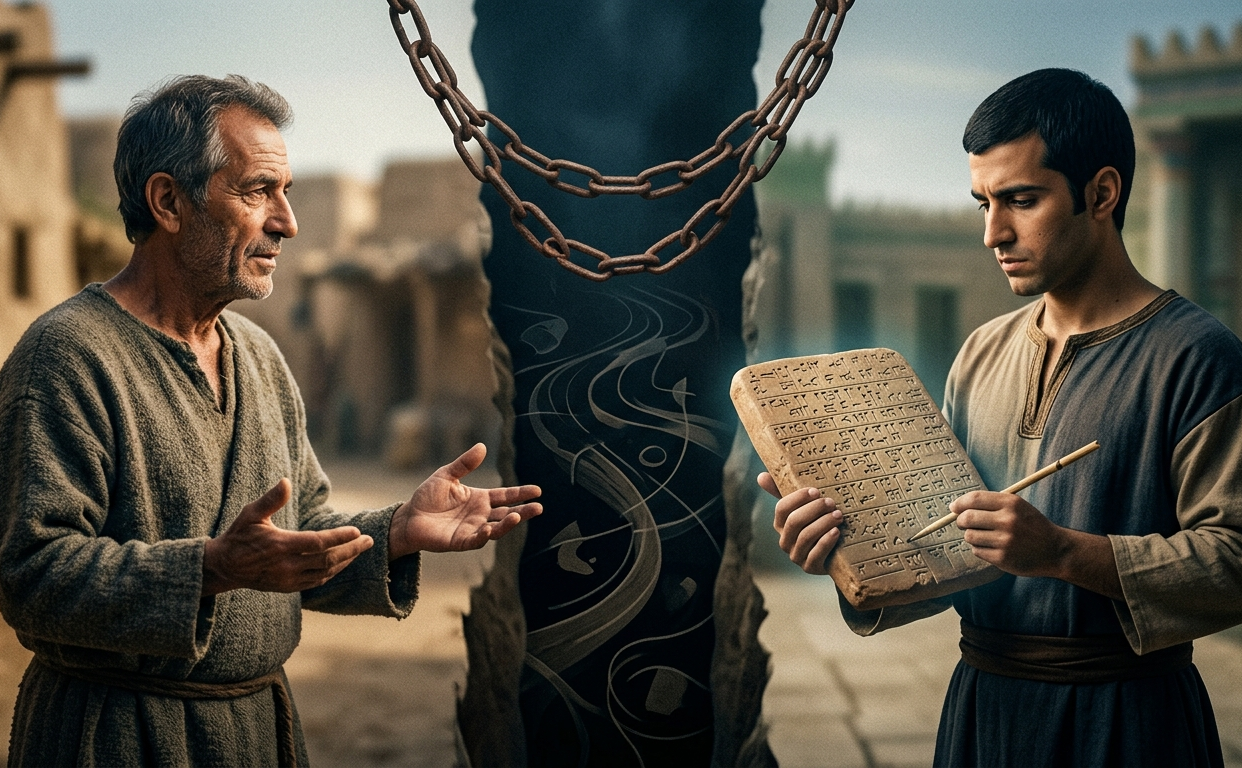
The earliest script we have recovered, the proto-cuneiform of southern Mesopotamia, pressed into wet clay more than five thousand years ago, is not literature. It is bookkeeping. Lists of grain, sheep, oil, and beer. Quantities in, quantities out. The name of the thing, the number of the thing, and eventually the name of who it belonged to. That is the whole of it.
The scholar who spent her career tracing how those marks emerged from older clay counting tokens puts it plainly: before roughly 2700 BC, writing is only accounting, only the record of what comes into the temple or the palace and what goes out.
The love poems and the laws and the epics come later, centuries later, riding on a technology that was invented to keep track of debt.
Stop and feel the weight of that, because it sets the shape of everything in this movement.
The first thing humanity learned to make permanent was not its wisdom or its wonder. It was its ledger.
The first person who could read was, by definition, the person who kept the accounts, which means the first literate human being on earth was an administrator of who owed what to whom. Literacy and debt were not cousins. They were born in the same act, in the same building, doing the same job.
And here is the quieter mechanism, the one that runs underneath the rest of the book. A word, once written down, begins to feel less like a choice and more like a fact.
The arrangement that someone decided then becomes the arrangement that simply is. Because there it sits in the clay, in the same indelible script that records the height of the river and the count of the stars. The word is the first technology for making a thing feel permanent before anyone has had the chance to ask whether it should be. By the time the next generation is born, the categories are already waiting for them, fully formed, looking exactly like nature: the freeman and the slave, the noble and the commoner, the one who is owed and the one who owes.
None of those were facts of the world. They were entries in a ledger. But a child who inherits a word inherits it as weather, not as a decision someone made and could have made differently, and that inheritance is one of the oldest and most invisible walls there is.
The word economy comes down to us from the Greek oikonomia, the management of a household, from oikos, household, and nomos, law or custom. The law of the household. The first economists were the people who ran the great household of the temple, and the household they were managing was, increasingly, everyone.
To the top of the ladder: which of the categories you benefit from did you inherit as nature, written down long before you arrived, and what would it cost you to admit someone simply decided it?
To everyone else: what word has been used to file you into your place, and have you ever held it up to the light and asked who first pressed it into the clay, and why?
Chapter Comments
Reading-only view here. Join or reply in the full forum thread: Open Discussion
No comments yet for this chapter.