
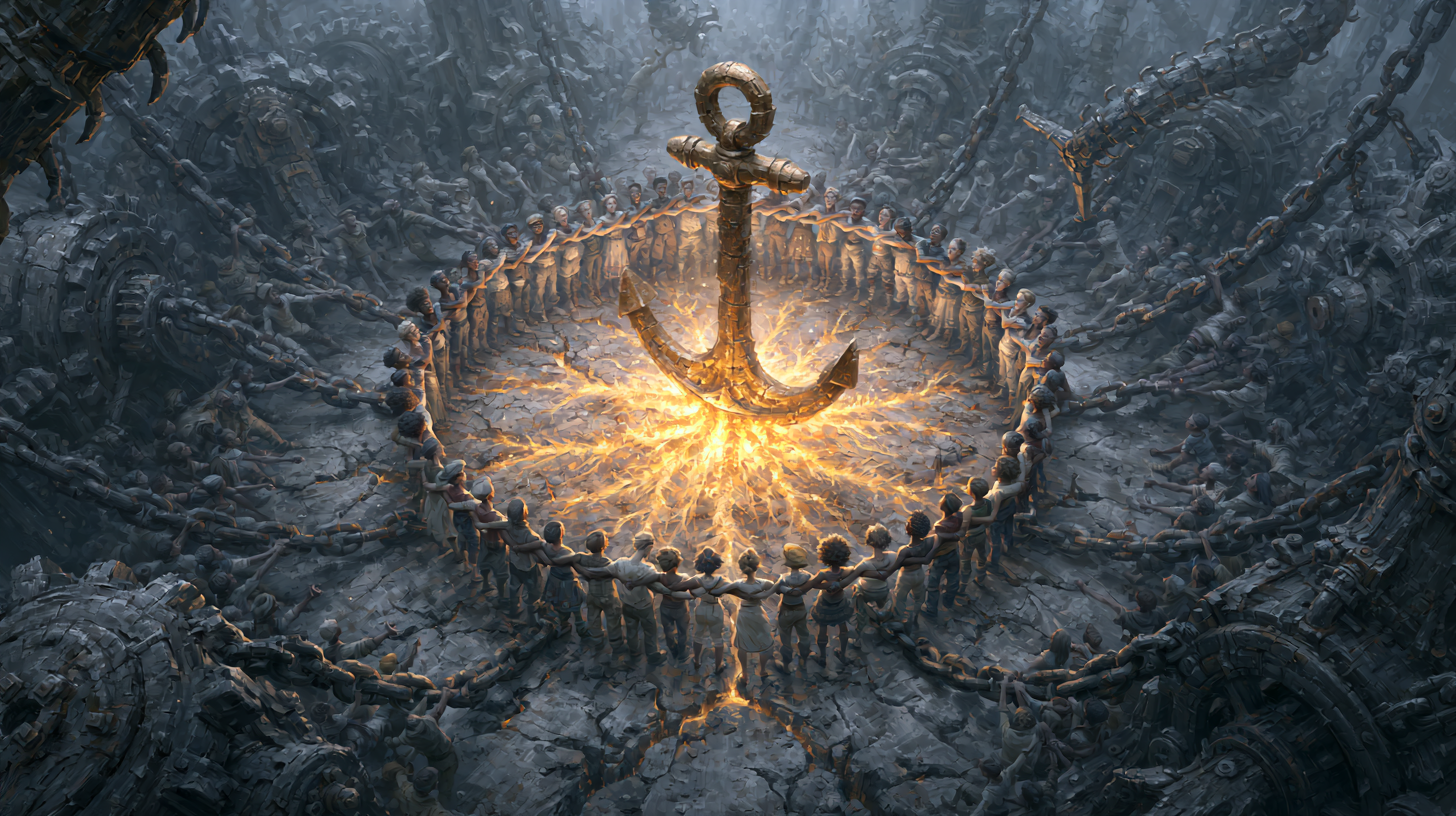
The book has described the brake in mostly individual terms. The prefrontal mechanism that arrives late and can be worn down and turned around. The first room where it is first built or broken. The conditions of play that let it finally run quiet. All of that is real. And it is incomplete in a specific and important way.
Some brakes are only load-bearing together. You cannot build them alone and you cannot maintain them alone and the machine knows this. This is why one of its oldest and most reliable projects is the removal of the conditions under which people build them together.
The word for the together-built brake is mutual commitment: the explicit or customary agreement among a group of people to hold each other to a standard that none of them could hold alone.
The union that says no one works below this wage so that no individual worker has to choose between their principles and their survival. The cooperative that says the surplus belongs to the people who produced it. So that no individual member has to fight that battle alone against a buyer who holds all the cards. The community land trust that says this ground stays in the commons so that no individual family has to watch the market price them out of the neighborhood their grandparents built.
The peer-monitored commons that Elinor Ostrom spent a career documenting: the fishing ground, the pasture, the irrigation system, managed not by a state and not by a market. But by the people who use it, through rules they built themselves. Enforced by the mutual watching that makes defection visible and costly before it destroys the resource.
Ostrom won the Nobel Prize in Economics in 2009 for proving what every fishing village and every grazing community and every irrigation cooperative had known by practice for centuries: that the commons does not have to be tragic.
The tragedy of the commons. The famous argument that any shared resource will be depleted by rational individual self-interest, is not a law of nature. It is a description of what happens when the mutual commitment mechanisms are removed. Leave the mechanisms in place and the commons holds.
The people sharing the resource manage it themselves. They monitor usage, penalize those who take too much, and resolve disputes through trusted local channels.
Crucially, they defend their system against outsiders who want to privatize or regulate it.
This is not utopia. It is documented practice, in hundreds of cases across every inhabited continent. In communities that had never heard of Ostrom or of each other.
Now run this against the book’s recurring argument about atomization. The watchers watching each other post named the peer enforcement that makes cruelty the default: the community that quietly stops inviting the person who said the uncomfortable thing, the colleague who distances from the one who spoke up.
That is peer enforcement in service of the arrangement. The collective brake is the same social technology pointed in the opposite direction: the community that quietly makes clear that certain behaviors are not acceptable here, that the person who cheats the commons will find their standing in the group costs them more than what they took.
Peer enforcement runs downhill toward the arrangement when the arrangement controls what the peers enforce. It runs uphill against the arrangement when the peers have built their own mutual commitment that does not answer to the arrangement’s definitions of acceptable.
The machine cannot atomize people completely. It can only make the building of mutual commitment more expensive than most people can afford most of the time. By keeping the conditions of precarity and alarm high enough that the brake never gets the quiet it would need. A person working three jobs to service the dead pledge from the banks and property post does not have the surplus time, energy, or safety that building a functional commons requires.
That is not an accident. It is the design, the same way that keeping the body under enough alarm prevents play. The precarity that makes collective brake-building unavailable is part of what the extraction produces and part of what keeps the extraction running.
Which means the path to the collective brake runs through exactly the same place as the path to play: the restoration of enough safety that the surplus required for building something together is available. Not comfort.
The specific condition of knowing that the experiment is permitted to fail without destroying the experimenter. That condition is what makes both genuine play and genuine mutual commitment possible. It is the condition the machine most reliably destroys in the people it most needs to keep from organizing.
To the top of the ladder: what mechanisms of mutual commitment among the people below you have you priced out of existence, and how much of your extraction depends on their inability to build the collective brake that would make certain things not acceptable here?
To everyone else: what would it take to build the mutual commitment that makes the costly question survivable to ask out loud, not alone but together, so that no single person has to pay the whole price of asking?
Chapter Comments
Reading-only view here. Join or reply in the full forum thread: Open Discussion
No comments yet for this chapter.