

Before the salt monopoly there was something that made the salt monopoly possible. Before the first wall there was the thing every wall is built on. Before any king claimed any resource there was a prior claim, older than kings, older than the word for king, that most of what followed was simply an elaboration of.
Someone claimed the ground.
Not all at once. Not with a document or a ceremony. The first land claims were not events. They were accumulations, the slow hardening of habit into custom, of custom into right, of right into nature. A family that camped in the same valley for enough seasons began to feel, and then to say, and then to enforce, that the valley was theirs. The group that planted and harvested the same field for enough generations did not experience the field as something they had taken. They experienced it as something they were.
The claim became invisible the way all old claims become invisible, by outlasting the memory of the claiming. This is the most important sentence in the book, and I want you to hold it before the history begins. Every other wall in these pages is built on top of this one.
The salt is in the ground. The water is in the ground or flows across it. The seed grows from it. The mine is under it. The factory stands on it. The trade route runs across it. The temple sits on it. The palace commands it.
The person who has no ground has nowhere to stand and must require permission from someone who has some. Which means every negotiation they ever enter, every wage they accept, every price they pay, every claim they make on any other resource; this all happens inside someone else’s enclosure before the conversation begins.
The land claim is not one wall among many. It is the wall the other walls are built on, and whoever holds it holds a prior claim on everything that grows from it, flows through it, or stands on top of it.
The archaeology is clear that land claiming preceded formal civilization, not by centuries but by millennia. Hunter-gatherer groups defended territories. Pastoral groups followed and protected seasonal routes with the same ferocity that settled farmers would later defend fields. The transition to settlement did not invent the territorial claim. It made it permanent, which is a different and more consequential thing, because a permanent claim can be passed down, and a claim that is passed down long enough stops being a claim and becomes an inheritance, and an inheritance stops being an inheritance long enough and becomes the shape of the world.
Here is how the claim gets sealed, and watch this carefully because it is the same move the book will trace through every subsequent century.
First the claim is made by force or by arrival. Then it is held long enough that the forcing recedes from living memory. Then it is written into law, so that challenging it means challenging the law itself, not just the original act. Then a story is built around it, about stewardship, about improvement, about the natural right of those who work the land or develop it or were here first, and the story is true enough in enough cases that it is very difficult to separate the honest version from the one that simply protects the ambiguity. Now the question of who made the original claim, and whether they had the right, and what happened to the people who were using the ground before them; that is filed under history, under settled, under the past, and the present arrangement inherits all the legitimacy that time and story have deposited on top of it.
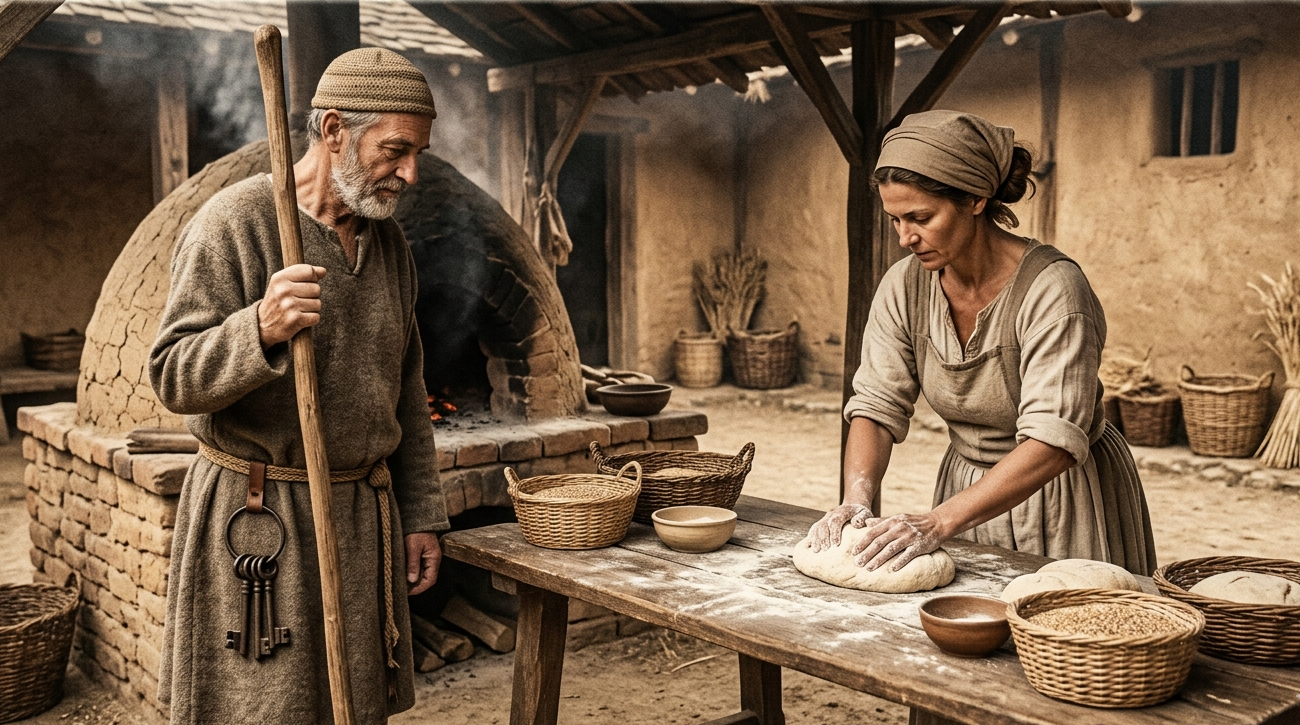
The word lord comes from the Old English hlaford, the bread guardian, the one who holds the loaf. The word lady from hlaefdige, the bread kneader, the one who makes it. Even the words for the highest human authority in the language began as descriptions of who controlled the food, which began as a description of who controlled the ground the food grew from. Power and the land claim have been the same thing, at the root, since before the words for either existed.
To the top of the ladder: how far back does your claim to the ground you stand on go, and what was done to get it and hold it that the present arrangement would prefer not to examine?
To everyone else: whose permission are you living under, and when did you last ask how that permission came to be theirs to grant?
Chapter Comments
Reading-only view here. Join or reply in the full forum thread: Open Discussion
No comments yet for this chapter.