
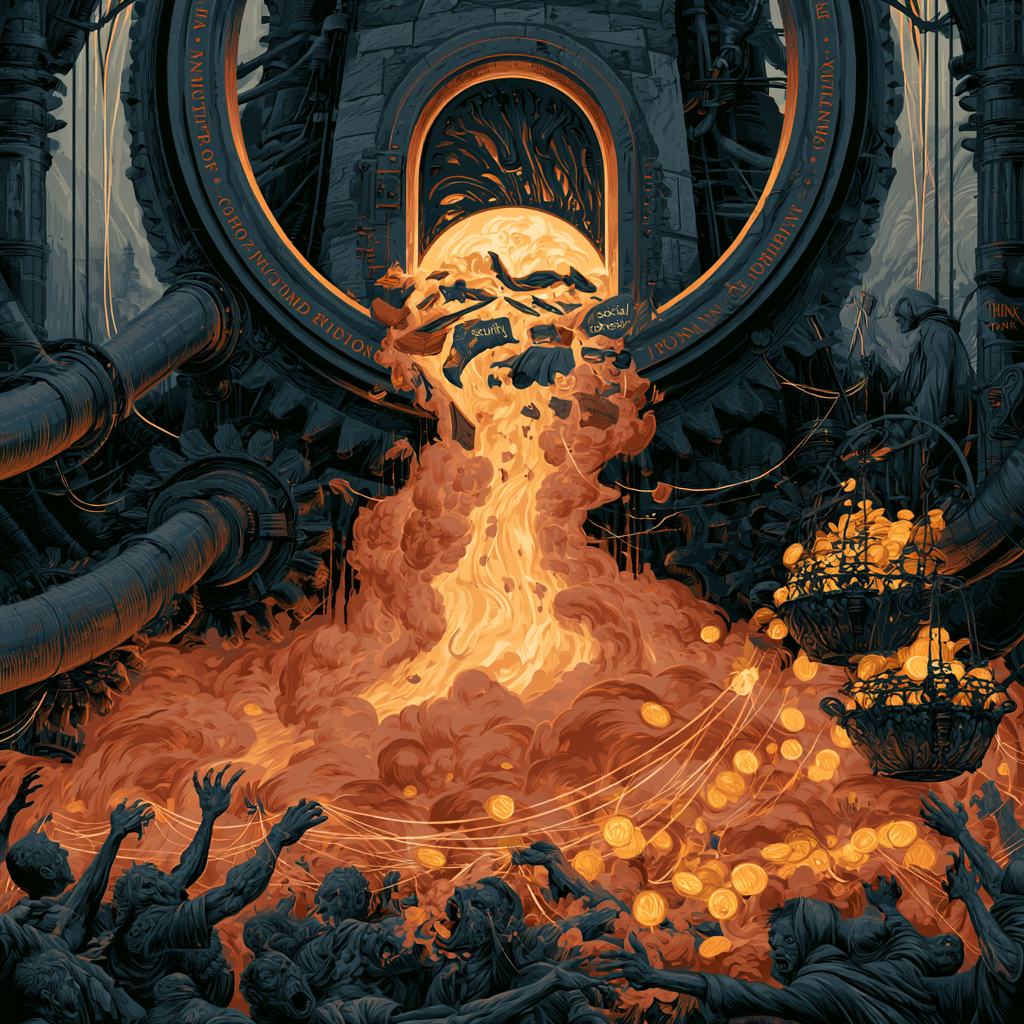
Every other extraction in this book has the same basic shape. Something the body or the identity needs already exists: the salt, the water, the ground, the belonging, the meaning. The machine finds it, puts a gate in front of it, and charges for the passage.
The thing being gated was always there. The machine arrived afterward.
The arms trade is the inversion. It does not find a thing people need and gate it. It manufactures a condition people need to escape and then sells the escape. The product and the demand for the product are the same event.
War destroys capital, infrastructure, population, and the security of everyone inside its range. The arms manufacturer profits from the destruction. The reconstruction contractor profits from the rebuilding. The lender profits from the debt taken on to fund both. And the next war replenishes the demand. The machine does not merely survive conflict.
In this specific configuration it requires conflict the way the engineered food requires hunger. Remove the hunger and you have no market. Remove the conflict and you have no customer. The business model is a perpetual motion machine fueled by human catastrophe.
This was not always hidden. In the United States, in the 1930s, a Senate committee chaired by Gerald Nye spent three years investigating how American munitions manufacturers and financiers had behaved during and before the First World War. What the committee documented was plausibly not a secret conspiracy but a business logic operating in plain sight. Manufacturers had sold to both sides. Firms had lobbied against peace negotiations. Bankers who had financed Allied debt had a direct financial interest in American entry that would protect their loans.
One of the committee's witnesses observed that when the government was deciding whether to restrict arms sales to warring nations, the manufacturers were in the room, and the people who would die in the wars were not.
The committee's findings were contested and its conclusions were argued over for decades, but the core documentary record, the contracts, the lobbying records, the communications between manufacturers and government officials, was not invented. The Merchants of Death was the name a 1934 book gave to the people the documents described, and the name stuck because the documents supported it.
By 1961 the configuration had matured into something the five-star general who had commanded the war felt it necessary to name in his farewell address to the nation. Dwight Eisenhower called it the military-industrial complex. It was in a speech that is routinely quoted for the warning and rarely read for the mechanism.
Eisenhower was describing a loop, not a conspiracy. The defense contractor funds the congressional campaign. The congressman approves the defense budget. The budget funds the contractor. No one in the loop is required to intend the outcome. Each is simply following the incentive that the structure provides.
The loop eventually runs on its own once it gets big enough. At a big enough scale, everyone involved shares the exact same financial interest. This includes the contractor, the congressman, the retired military officer on the contractor's board, and the think tank writing threat reports using the contractor's funding.
They do not need to coordinate because the structure coordinates them. The water flows downhill and calls it strategy.
The think tank is the piece that connects the Merchants to the rest of this movement. The threat that justifies the budget must be kept credible. A threat that disappears is a threat that shrinks the budget. The defense contractor needs a large budget, so they fund the think tank. In return, the think tank produces analysis that keeps the public afraid. They spot an enemy behind every horizon, constantly turning everyday geopolitics into a crisis.
This is the doubt machine from the doubt post, run in reverse. The doubt machine manufactures uncertainty about a settled truth to prevent action. The threat machine manufactures certainty about a contested threat to compel it. Both are the production of a specific epistemic condition for profit. Both use the same technique: fund the analysis, place the analysts, and let the credentialed voice do the work that a naked commercial claim could never do.
The resolve here is the hardest in the book to enact and the simplest to state. It has been done, in pieces, in real places, which is the only reason it can be named without lying.
The loop is severed at the funding seam: the threat analysis the public relies on must not be paid for by the people who profit from the threat being believed.
The deeper resolve is the one Eisenhower's generation half-built and then let lapse. The conversion of war production into peace production. The documented programs that turned arsenals into civilian industry when a war ended. So that the workers and the towns and the supply chains that depended on the weapons did not become a permanent constituency for the next war.
The loop runs because cutting the budget threatens real jobs in real districts. Which is the human hostage the structure holds.
Conversion is the friction that frees the hostage: build, in advance, the civilian work that the military work can become. This way peace stops being the thing that ruins the town. Where that was done, the loop weakened. Where it was never done, the town votes for the war because the war is its only paycheck, and the loop holds.
Now the transition that the next post completes: what happens when the external battlefield runs out, or when the domestic population begins to notice the loop?
The answer is in the next post. The apparatus that was built to find and neutralize external threats does not disband when the threat diminishes. It finds a new adversary. The adversary it finds, because it is the adversary closest to hand, is the domestic population that is asking questions about the loop.
The watchers turn inward not because someone decided to become tyrannical but because the machine cannot afford to stop watching, and the only thing left to watch is itself.
To the top of the ladder: how much of your budget, your institution, your position depends on the continuation of a conflict or a threat that your budget, institution, and position also help to perpetuate, and what would happen to all three if the conflict resolved?
To everyone else: who is being paid to tell you that the threat is real, and who funds the person being paid, and what happens to the funding if the threat turns out to be manageable?
Chapter Comments
Reading-only view here. Join or reply in the full forum thread: Open Discussion
No comments yet for this chapter.