
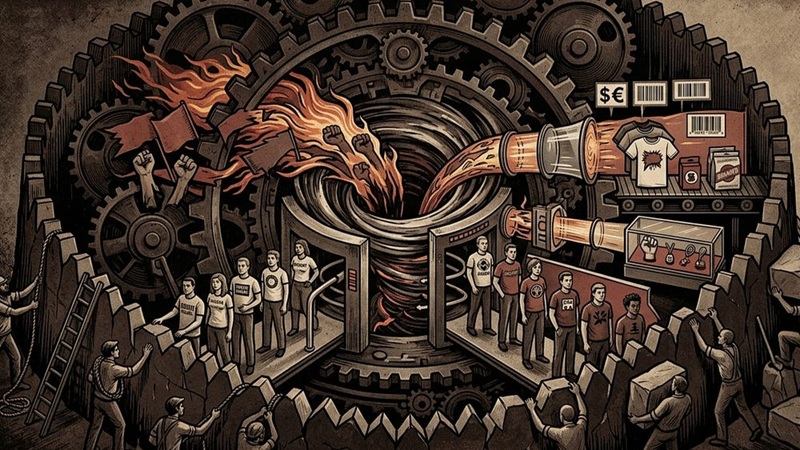
The book described the machine absorbing critique as content and profiting from the attention the critique generates. That is the passive form of the move. There is an active form that is more sophisticated and more invisible, and it has been running since the first king discovered it. The discovery is that the most dangerous dissenter is the one the crowd has decided to follow.
The active form is this: when genuine resistance builds enough momentum to threaten the structure, the machine does not only try to crush it or wait it out. It builds a marketplace around the resistance.
It takes the language of the rebels, strips it of its structural teeth, and sells it back as a product. It creates a rung on the ladder for the dissenter, so that the dissent becomes a position within the arrangement rather than a challenge to it.
The rebel becomes a brand. The exit door becomes a revolving door that charges admission. The Situationists called this recuperation in the 1960s, watching it happen to their own movement in real time:
the radical critique of consumer society turned into an aesthetic that consumer society absorbed and sold.
The punk movement, which began as a genuine refusal, within a decade had its own section at the mall. The counterculture of the 1960s produced an enormous market in counterculture products, and the people buying the products felt they were participating in the counterculture while feeding the exact supply chains the counterculture claimed to oppose.
The language of social justice became a brand positioning strategy.
The language of sustainability became a marketing category. The language of authenticity, which was itself a critique of manufactured identity, became the most manufactured identity of all, premium-priced and algorithmically optimized.
Notice what the recuperation move does to the person inside it. They are not deceived in the crude sense of being told a lie. They are doing something that genuinely feels like resistance.
The feeling is real: the purchase, the aesthetic, the identity, all of it carries a genuine charge of opposition. A real experience of being not like the people who do not see what they see.
What has been removed is the structural connection between the feeling of resistance and any action that changes who controls the necessity.
The energy of the dissent has been captured and metered back through the gate. The person is paying for the experience of opposition while the gate they are opposing remains exactly where it was.
The tell is the same tell the book has named throughout: genuine resistance does not need a premium tier. The union that works does not have a lifestyle brand. The cooperative that changes the terms does not have a logo optimized for sharing.
The mutual commitment that builds the collective brake does not require an algorithm to find its audience, because it does not have an audience. It has members, and the membership means something different from a follow, because it costs something real and asks something real in return, and the asking and the cost are the thing that makes it load-bearing rather than decorative.
To the top of the ladder: which resistance movements against your arrangement have you metabolized by building a marketplace around them, and whose energy is now flowing through your gate wearing the costume of opposition?
To everyone else: which of your dissent is purchasing the feeling of having acted without having changed anything the machine cares about, and what would it cost you to trade the brand for the mutual commitment that does not need a logo?
Chapter Comments
Reading-only view here. Join or reply in the full forum thread: Open Discussion
No comments yet for this chapter.