
The mandate in the previous post explains how the arrangement gets written into heaven. But heaven is far away and the arrangement has to be enforced every day, at street level, by people who are not kings and not priests and not soldiers.
The machine cannot post a guard beside every person who might ask the wrong question. So it does something cheaper and more durable. It recruits the crowd.
The tribe is not manufactured from nothing. That is the part worth being careful about, because getting it wrong turns this into a cynical account of human belonging and it is not that. The tribal instinct is as old and as real as the hunger for salt. For almost the entire span of human existence, the group you were born into was the thing that kept you alive. It fed you, defended you, told you who you were, where you were, and what the world meant.
The need to belong to a group, to know who is us and who is them. To feel the warmth of being on the inside and knowing there is more alarm outside, this is not a flaw the machine installed. It is the oldest social technology the species has, and it kept your ancestors alive long enough to make you, the same way the hunger for sugar kept them reaching for the ripe fruit.
The machine did not invent the tribe. It learned to point it.
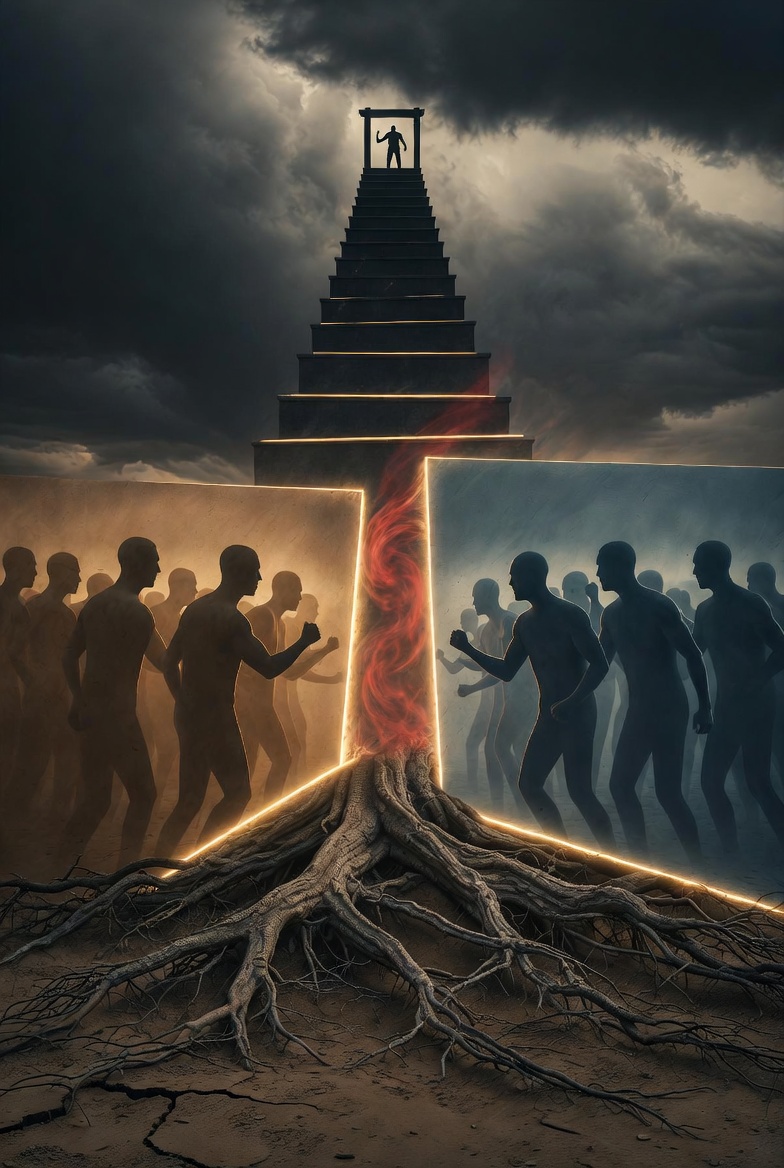
Here is the move, and once you see it you will see it in every century this book has covered and in every news cycle you will ever read. Take a genuine grievance, a real loss, a real fear, something that actually hurts the people you are trying to recruit. Now attach it not to the structure that produced the loss but to a group of people who can be made to stand for the structure.
The loss is real. The target is a substitution. The people below you on the ladder, the ones the structure is also extracting from, become the explanation for your pain instead of the people in the room above you who arranged the extraction.
The anger that could travel upward, toward the gate and the gatekeeper. Instead it is rerouted sideways, toward the neighbor, the immigrant, the other faith, the other color, the other side of the line the map drew last century.
The rerouting does not have to be conscious on anyone’s part to work. It only has to be cheaper than the alternative. The person who names the structure, who says the problem is the gate not the neighbor, is asking you to fight something large, invisible, and dangerous. The person who names the neighbor is offering you something you can see, someone you can blame today. A story that explains your pain without requiring you to confront the thing that is actually causing it.
The second offer is easier, it feels more like relief. It comes wrapped in the tribal warmth of being with your people against the other people, which is one of the oldest and most powerful feelings a human body knows.
This is why the book will not name the golden rule directly beyond this in any of its posts. You already know the golden rule. Everyone does. The machine knows it too, and the machine’s answer to the golden rule is the tribe: it gives you a category of people the rule does not apply to, people who have been made strange enough, threatening enough, different enough, that the normal human response of recognizing another person as a person can be suspended. Then the suspension feels not like cruelty but like self-defense.
The seal on the golden rule is the line that divides us from them, and that line is one of the cheapest and most renewable tools the machine has ever found.
The word tribe reaches back through the Latin tribus, the three original divisions of the Roman people, to a root meaning simply the division, the part, the portion. The tribe was always a way of dividing the whole into parts. What the machine learned was that the division, carefully managed, prevents the parts from ever seeing the whole.
To the top of the ladder: whose anger are you rerouting sideways right now, and toward what neighbor, and what question about your own conduct does that rerouting prevent from being asked?
To everyone else: whose pain have you been handed an explanation for that points at someone beside you on the ladder rather than at the structure above you both, and what would you have to give up to aim your anger at the right thing?
Chapter Comments
Reading-only view here. Join or reply in the full forum thread: Open Discussion
No comments yet for this chapter.